- 1.Titans
- 2.Vikings
- 3.Steelers
- 4.Saints
- 5.Giants
- 6.Chargers
- 7.Patriots
- 8.Colts
- 9.Falcons
- 10.Texans
- 11.Bears
- 12.Eagles
- 13.Dolphins
- 14.Packers
- 15.Buccaneers
- 16.Jaguars
- 17.Cardinals
- 18.Panthers
- 19.Cowboys
- 20.Redskins
- 21.49ers
- 22.Ravens
- 23.Bills
- 24.Seahawks
- 25.Bengals
- 26.Broncos
- 27.Jets
- 28.Rams
- 29.Chiefs
- 30.Browns
- 31.Lions
- 32.Raiders
In the beginning, there were institutions...thoughts on institutions, economics and other random topics.
Tuesday, September 8, 2009
NFL Rankings
The office kid
I have a better idea. Instead of cooking up a scam, organize the market so the single workers get paid to "take their turn" getting "time off" for dealing with their coworkers' kid-related problems.
Our Portfolio of Imperfect Institutions
First, a large share of our economic output is now produced by large companies whose sales exceed the gross domestic product of many countries of the world. The vertically integrated supply chains of these large, often bureaucratic institutions seldom involve markets....
Second, market output represents a subset of total economic output. ...time and energy to caring for ourselves, our families and our friends ... activities that improve our own living standards ... men now devote more time to housework and child care than they once did. As we move toward more equitable sharing of unpaid work, policies designed to help wage earners meet their family responsibilities ... seem expensive to us in part because we have taken women’s unpaid work for granted in the past.
Third, the present and future costs of environmental degradation are on the rise.
Markets aren’t the only imperfect institutions in our world. Governments, families and Mother Nature are also susceptible to failure.
The point is, like it or not, we rely on a portfolio of imperfect institutions — a mixed economy.
Silly Anti-Reagan Conservative Health Care Protesters
Monday, September 7, 2009
More Economist Humor
Reminds me of the old Woody Allen line, "Those who can't do, teach. Those who can't teach teach gym."
Sentence of the Day
Responsibility is a more important value than either liberty or equality.The whole post is worth reading but that point (the last) is the keenest.
Friday, September 4, 2009
Damn Imported Bald Eagles
More on the similarities between Presidents Obama and...
Yup, I've covered it before: Nixon was a self-proclaimed Keynesian; Nixon proposed a "negative tax" that would effectively reform welfare and still help the poor. Now, I've seen it all. Nixon favored a national health program that offered universal coverage. Here's proof. The principles of it:
First, it offers every American an opportunity to obtain a balanced,
comprehensive range of health insurance benefits;
Second, it will cost no American more than he can afford to pay;
Third, it builds on the strength and diversity of our existing public and
private systems of health financing and harmonizes them into an overall system;
Fourth, it uses public funds only where needed and requires no new Federal
taxes;
Fifth, it would maintain freedom of choice by patients and ensure that
doctors work for their patient, not for the Federal Government.
Sixth, it encourages more effective use of our health care resources;
And finally, it is organized so that all parties would have a direct stake
in making the system work--consumer, provider, insurer, State governments and
the Federal Government.
If Tricky Dick were running for his old senate seat today, he'd probably either have to run as a democrat, or he'd lose in the primary to someone who has no shame in calling him a socialist. Interesting how the political tides in the Republicanist party have shifted to the extreme.
Thursday, September 3, 2009
Economic History and the Variety Gains from Trade
The thing to highlight here is the importance of TRADE. Without expanding trade, it is doubtful that tea, coffee, and sugar could have ever become available. Hence, variety gains from trade. It only took until 1980 for Krugman to formalize it in the trade literature.Tea reached Europe from China in 1606, spreading to France in 1630, and finally to England in 1650...Coffee spread through the Middle East and arrived in Europe in 1615. Sugar, available before 1500 in limited quantities, only became affordable once production centres developed in the Caribbean starting in the mid 17th century.
By the end of the period, sugar, coffee, and tea constituted 7.2% of an average English household’s budget, and roughly 10% of their food expenditure...To put this in perspective, personal consumption expenditure on personal computers in the US in 2004 was only 0.6% of consumption expenditure, meaning that, by at least one metric, the average Englishman valued sugar more than the average American values his or her computer...
Prior to 1700, the average European consumed 182 kg of bread and 182 litres of beer per year...Half of all spending was on beer and bread, and fully three-quarters of all calories came from these two sources alone. The reason for massive beer consumption was simple – water was often contaminated. This was especially true in the cities. Brewed beer was safe. It is hence not surprising that it was consumed throughout the day, often with breakfast, and in all forms – including as beer soup in the morning...
Minivans, satellite TV, the internet, and mobile phones have made life better. The single biggest addition to welfare comes from the introduction of personal computers, credited by Greenwood and Kopecky with a gain of 3.5-4% of consumption expenditure. Compared to these figures, the gains for coffee, tea, and sugar look very large.
Wednesday, September 2, 2009
Some Links
Bayesian analysis of support for school vouchers; it would be interesting to see for health care.
When supply is low, the price is high: Womens' attitudes towards monogamy and the relative supply of marriagable men.
Probability is the oil of rationalization: "To rationalise a choice you want to make, you choose costs and benefits that lead to your choice seeming like the rational conclusion."
And to complement the previous: Ice versus soda cost-benefit analysis.
Tuesday, September 1, 2009
Economic Indicator of the Week
Saturday, August 29, 2009
Pythagoras's Student
I have to think today, instead of putting Hippasus to death, Pythogoras would have stolen the proof and claimed it for himself.
Hippie Deoderant
Tuesday, August 18, 2009
Secondary Environmental Impact of "Cash For Clunkers"
Sampling and Newsertainment Polls Dymystified
| The Daily Show With Jon Stewart | Mon - Thurs 11p / 10c | |||
| Poll Bearers | ||||
| www.thedailyshow.com | ||||
| ||||
For those who are interested, here's a link to the equally-funny "moment of zen..."
Best "Moment of Zen" Ever
| The Daily Show With Jon Stewart | Mon - Thurs 11p / 10c | |||
| Moment of Zen - Coulter Sells More Books | ||||
| www.thedailyshow.com | ||||
| ||||
Monday, August 17, 2009
Perfect Information: The Movie!
Sunday, August 16, 2009
Question about the housing bubble/financial crisis.
Friday, August 14, 2009
Krugman's Pants
Thursday, August 13, 2009
The usefulness of Venn Diagrams
lose to (who teaches junior high math) mocked the usefulness of Venn
Diagrams. Of course, they're pretty useful to illustrate logical
relationships, and according to Nate Silver at 538, Mr. Huckabee could have used them this past spring.
Conspiracies and Economic Statistics
In my view, the reason why so many hold onto these views is because it's so much easier to remain ignorant, and leap to the conspiracy view, than to do the hard work to understand why the statistics are imprecise measures of economic concepts, and why they are revised over time. After all, the former requires nothing more than taking somebody's word, the latter entails reading the supporting documentation, comprehending what the terms used mean, and applying some basic math and statistics skills...In other words the reason conspiracy theories attract a nice crowd of supporters is because people are "rationally ignorant." Being informed takes a lot of effort, and it's easy to believe a plausible lie (along with a dose of paranoia that the other side is lying) than it is to be bothered with the facts.
Wednesday, August 12, 2009
Interesting Happiness Map
Pot is a NORML good
Improving Math Skills
Monday, August 10, 2009
Change the "Price"
A lot of comparisons are out there, by the way, with anti war protests and their rancor. In a way, that's true, but those protesters generally kept their protests to the streets - they were seldom allowed into the "meetings" or "discussions" Bush and other Republicans held to preach to their base.
Friday, August 7, 2009
Tyler Cowen on Progressivism
6. Limiting inequality will do more to check bad governance than will the quixotic libertarian attempt to limit the size of government.
8. We should support free trade, more immigration, and more foreign aid, but the nation-state will remain the fundamental locus for redistribution. That means helping the poor at home more than abroad; a decision to do otherwise would destroy political equilibrium and make everyone worse off.
Dr. Cowen is generally a skeptic of government interventions, so it will be interesting to see his critiques.
Mark Thoma on Economic Models
But all the tools in the world are useless if we lack the imagination needed to build the right models. Models are built to answer specific questions. When a theorist builds a model, it is an attempt to highlight the features of the world the theorist believes are the most important for the question at hand. For example, a map is a model of the real world, and sometimes I want a road map to help me find my way to my destination, but other times I might need a map showing crop production, or a map showing underground pipes and electrical lines. It all depends on the question I want to answer. If we try to make one map that answers every possible question we could ever ask of maps, it would be so cluttered with detail it would be useless, so we necessarily abstract from real world detail in order to highlight the essential elements needed to answer the question we have posed. The same is true for macroeconomic models.I may have to use that in class.
Tuesday, August 4, 2009
Worth Sharing
If you like the Post Office and the Department of Motor Vehicles and you
think they’re run well, just wait till you see Medicare, Medicaid and health
care done by the government.
- "Economist" Arthur Laffer during an appearance on CNN.
1. I've never had a problem with the Post Office.
2. The DMV is run by the states not the federal government.
3. Medicare and medicaid are the health care of almost 20% of all americans is already done by the government
Relating things back to Trade and FDI
4.9%
More on Stupid Meetings
In a badly-managed business, you get massively-multiplying meetings: every
decision, no matter how tiny, ends up being debated and signed off on
by far too many people, who thereby get to feel (and show their bosses)
that they’re Doing Something.
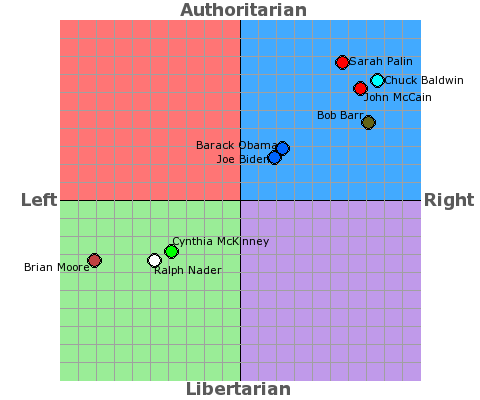
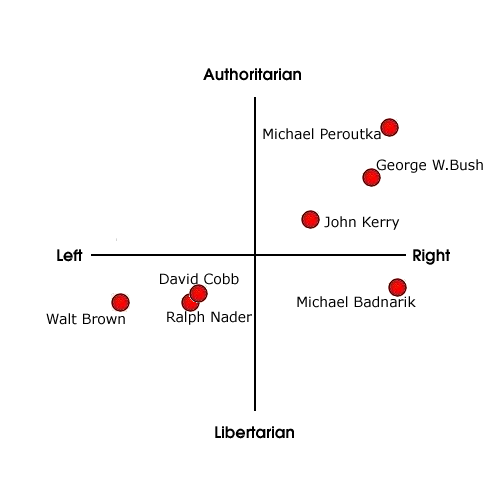
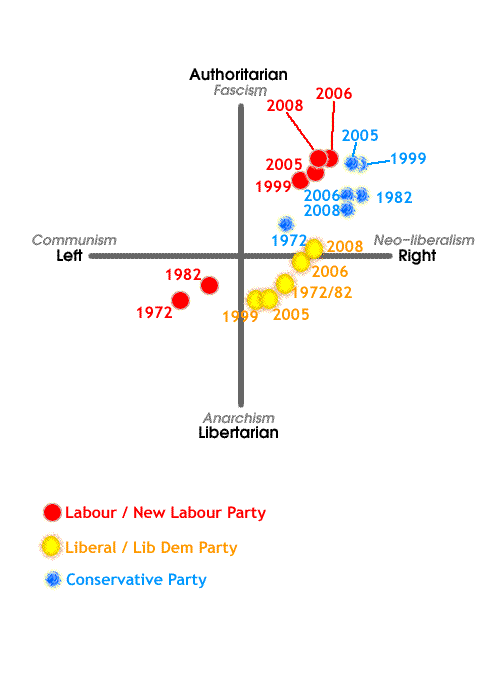
More on the Political Compass
Economically, putting magnitudes on preferences (cardinal utility) is something that has been recognized as fruitless for some time, although political scientists and psychologists still try to do so. This leads to the crux of the various "impossibility theorems" in the various critiques of the notion of "social welfare" in economics.
Inter-personal comparisons of "utility" or magnitudes of preference in a survey like the Compass requires me to assume that both people know what is meant by "Agree" as opposed to "Strongly Agree" in the Likert Scale, that they agree on that meaning, and so on. Usually, people don't agree on the intensity meant by "Strongly" in these surveys and the study faces the problem of not having "Inter-Rater Reliability." For a statement like, "If economic globalisation is inevitable, it should primarily serve humanity rather than the interests of trans-national corporations," it can be hard to have strong feelings for or against because "serve humanity" can mean different things to different people. Also, are the interests of "humanity" and "corporations" necessarily conflicting? I put "agree" on this because I think that freer trade and factor movements do serve humanity even if they serve corporations in the process. How intensely to I believe this? I guess pretty strongly, but the loadedness of the question makes me tentative.
My suggestion for the authors would be to make the survey binary - "agree" or "disagree." That way, their index would map to a well-defined and well-calibrated as a ratio-scale varilable. The current scale for the responses maps to a poorly calibrated interval-scale variable (and probably give a better dispersion of views for comparisons. Here are some pictures of their comparisons of various leaders:
Leaders:
Monday, August 3, 2009
Welfare and Liberty
Saturday, August 1, 2009
Political Compass
Your political compass
Economic Left/Right: 1.00
Social Libertarian/Authoritarian: -2.87
Friday, July 31, 2009
Life Expectancy Arguments
At birth, someone living in the Netherlands can expect to live 2.35 years longer than someone born in the US, but at age 65, the difference is reversed, and someone living in the US can expect to live 0.4 years longer than someone living in the Netherlands. This difference can be explained by assuming that semi-socialized health care is better for young and worse for old people, or, at least as likely, different policies are not the main cause of the difference
Sources: CDC national vital statistics 2004, www.cdc.gov/nchs/data/nvsr/nvsr56/nvsr56_09.pdf and RIVM 2007 levensverwachting, www.rivm.nl/vtv/object_document/o2309n18838.html (in Dutch)
So, the question still remains on distribution. Is it better to increase the likelihood that citizens are able to reach the age of 65 or that those who do (either because they are congenitally wealthier or healthier) live even longer? There are a lot of interesting tradeoffs in the debate, and the politicians are not focusing on any of them because the old conflicts over class and culture play better to less affluent voters (remember more than half of all Americans have below-average incomes).Credibility problem
Thursday, July 30, 2009
Today's reason neither politicians nor doctors want to lower costs
From a very good piece in the NYTimes on lobbying:
Hint: McAllen Texas has the highest health care costs in the country.One of the largest sources of campaign contributions to Senate Democrats during this year’s health care debate is a physician-owned hospital in one of the country’s poorest regions that has sought to soften measures that could choke its rapid growth.
According to the Times, the hospital has been quite successful in its efforts. And where is this powerful hospital with all the lobbying money located? Why in the metropolitan area of McAllen, Texas. McAllen, Texas? Hmmm...now where I have heard that name before?
Hmmm.
It's worth pointing out that PowerPoint presentations are generally better than many older classroom technologies, like slate chalkboards or overhead transparencies filled with hand-scrawled notes that students struggled to decipher. So computers have probably led to a slight improvement in teaching.So, as usual, it's not really so much the technology as much as it is how you use it. Technically, I use "smart boards" and "Power Point" but I almost never use pre-made slides anymore. I use the laser pen and palatte to draw and write the main points while I mention them. Over the last couple of semesters, students who complained about "boring power point" lectures were usually ones who had other issues with the difficulty of statistics generally or their grade specifically.
Also, I've been reading some studies on so-called "active learning." Much of it finds that active learning does not improve mastery of concepts. However, it does improve student perceptions (and teaching evaluations), and thus I have been investigating various gimmicks to introduce more "active learning" in my classes.
Wednesday, July 29, 2009
Small businesses also pay more for health insurance than large companies. According to the Commonwealth Fund, small businesses now pay 18 percent more than large businesses pay to obtain comparable insurance.Adverse selection?
Kenneth Arrow
Part one: Economics and business cycles
Part two: Health Care
I guess this is one of my favorite quotations from it:
One point was that health is a random event. It's not like buying automobiles. Whether you're sick or not is hard to predict. Some get sick and some don't. That uncertainty makes it an ideal scenario for insurance. Some houses burn and some don't, but you know whose. So you have fire insurance. (And by the way, financial problems have the same characteristics, and I was always interested in the subject -- the uncertainty.)Later,
But in the case of health care there are three players: the insurance company with the health plan, the physician, and the patient. The physician presumably has a better knowledge of what the patient needs -- at least better than the insurance company does. So the insurance company could never put together a bill. There is also a Physician and patient relationship, but the physician knows more than the patient.In other words, even if a 2 quart bottle of ketchup costing twice the price of a 1 quart bottle shows market efficiency for ketchup, insurance (and financial) markets work much differently. Of course, I've made these points about adverse selection and moral hazard casually myself, too, but getting them from a Nobel (who isn't Krugman) probably adds more weight.
There are information asymmetries in this story. Health insurance is limping along. It's limited in scope, and then you other consequences. Insurance companies have high premiums to protect themselves. The ones who come to the insurance company are sicker and the people have to pay more. You have adverse selection. You have moral hazard. And the doctor does what's on the safe side -- defensive medicine -- without regard to cost. These are fundamental conditions that make health insurance difficult.
On the policy side, Arrow had a nice result in his 1951 Ph.D. thesis known as the impossibility theorem.
Life Expectancy Math by Bill O'Reilly
I thought yesterday was funny. Bill-O shows his complete lack of statistical literacy in this clip.
Tuesday, July 28, 2009
Rational Explanation for Hating Meetings
I find one meeting can sometimes affect a whole day. A meeting commonly blows at least half a day, by breaking up a morning or afternoon. But in addition there's sometimes a cascading effect. If I know the afternoon is going to be broken up, I'm slightly less likely to start something ambitious in the morning. I know this may sound oversensitive, but if you're a maker, think of your own case. Don't your spirits rise at the thought of having an entire day free to work, with no appointments at all? Well, that means your spirits are correspondingly depressed when you don't. And ambitious projects are by definition close to the limits of your capacity. A small decrease in morale is enough to kill them off.
Each type of schedule works fine by itself. Problems arise when they meet. Since most powerful people operate on the manager's schedule, they're in a position to make everyone resonate at their frequency if they want to. But the smarter ones restrain themselves, if they know that some of the people working for them need long chunks of time to work in.
Emphasis added by me (for no particular reason).
Health Care Quality is Better in the US
What People Don't Know Could Fill the Oceans
At a recent town-hall meeting in suburban Simpsonville [SC], a man stood up and told Rep. Robert Inglis (R-S.C.) to "keep your government hands off my Medicare.""I had to politely explain that, 'Actually, sir, your health care is being provided by the government,'" Inglis recalled. "But he wasn't having any of it."
Friday, July 24, 2009
On Being Tall...
I suspect Greg Mankiw is not overwhelmingly tall. But, by Mr. Mankiws rationale is correct, why not tax being white, or male (after all, they tend to make more, on average, too)? I don't think Mankiw would support that. It might be because, even though it doesn't tax effort, discriminatory taxes that are based on the genes someone is born with would erode government credibility.
On a observartional note, I'm guessing if it were turned over to politicians, democrats would turn it into a short-person subsidy, and the republicans would make it a "tax credit" (which of course would be self-defeating as a redistributional matter since it would subsidize the short people who get paid highly the most). After all "tax" is a four letter word to politicians.
Of course, we all know what would happen here... Since, as conservative politicians point out, the whole financial-housing mess was caused by a law thirty years ago encouraging a small portion of loans to go to low-income homebuyers (somehow taking thirty years to work itself out), we can see the moral hazard here. Parents will deliberately malnourish their children to game the system and increase their chance of being eligible for the subsidy (or avoid paying the tax). Stop taking those prenatal vitamins, honey!
Wednesday, July 22, 2009
Insurance Generosity Curves
So, basically, 48 million Americans are on the horizontal segment; they don't pay for insurance, and they do not receive any benefits. Then if they pay some threshold per year (say, 2,000 for themselves and 5,500 paid by their employer as a "non-wage benefit") they get minimal coverage that increases in generosity as more is paid in.So, what might happen if the "public option" were introduced? What if it was lower quality as critics suggest? It might look something like this:

Thus, there would still be a discontinuity in the relationship, but at the bottom could be lifted without necessarily changing the rest. But, you might say, what about people who get seduced by the cheaper option? Here I ask, "what's the big deal?" The fact that they choose it when there are more generous (and more expensive options) proves that they are better off, on average, by revealed preference, and they have money to save up in case they want to pay in for a big procedure that the big mean bureaucrats won't pay for. The curve might look something like this:
If there are no distortions, then maybe the Feds insure 70 million or so, instead of the 48 million that were uninsured (but they also insure another 45-50 million from other existing public programs for a total of about 120 million people) If there are distortions, it might shift the curved segment like this:
Here, the benefits for people paying might decline, but the question is how much, it is unlikely that rich folks won't still have a "Cadillac option" that is as generous as they want it to be. (Another question is who are these people receiving the lowest benefits "on the new curve?" Are they people who had private insurance before, or are they on medicare/aid or other publicly-funded benefits? Are they people who were already at that level on the curve but decide to pay for the private option in spite of an available public option, i.e. to what extent are the "payers" moving horizontally, receiving the same benefits, versus down, receiving less, but still paying?)
One thing that this doesn't suggest, is that assuming inferior care by the government private insurance would go out of business. For that to happen, it's almost as if you would have to admit that the government plan is at least as good as a marjority of the points "on the curve." If they offer higher quality they should be able to keep charging a profitable price and compete on quality. If you think the government would compete the private insurers out of the market entirely, it's hard to make the case that their quality wouldn't be somewhat comparable.
An interesting note on the "fairness" of the Tax System
House or senate
Budget Hawks?
| Count of Vote | Party | |||
| Vote | D | I | R | Grand Total |
| Yea | 42 | 1 | 15 | 58 |
| Nay | 14 | 1 | 25 | 40 |
| Not Voting | 2 | 2 | ||
| Grand Total | 58 | 2 | 40 | 100 |
| Chi-Squared Test for Independence: | 15.207 | |||
From a Chi-Squared distribution with 4 [(r-1)*(c-1) with r = # of rows, c = # of columns) degrees of freedom, the 1% critical value is 13. 277, so since 15.2 is greater than 13.277, we can conclude in this case that there were differences. However, there may be lurking variables here, such as how much money gets sent to a district for the program. Maybe Republican states just get more financial benefit from defense-industry spending.
UPDATE:
To control for this a bit, I looked at states where the party differed. Here's the new crosstab:
| Count of Vote | Party | ||
| Vote | D | R | Grand Total |
| Nay | 2 | 7 | 9 |
| Yea | 10 | 5 | 15 |
| Grand Total | 12 | 12 | 24 |
| Chi-Squared Test for Independence: | 4.44 | ||
Here, we have a Chi-Squared distribution with one degree of freedom (there weren't any abstainers and I counted Joe Lieberman as a Democrat instead of "independent democrat"). The critical value for a 5% level of significance (still pretty good) is 3.841, so since 4.44 is greater than that, we can say that even controlling for state, there were significantly more Republicans who voted to keep the 2 billion dollar fighter in the budget.
Tuesday, July 21, 2009
To the Moon
Market Imperfections
Monday, July 20, 2009
Divided from Labor
Columbus, Trade, and the Moon
The moon missions were not motivated by economics or trade. As far as I know, no one believed there were little green men on the moon that we would want to trade with, or any strategic economic resources there that we could control. But, there were strategic reasons - we wanted to tout our technological superiority in order to taunt the Soviets and make them fear us.
Buzz Aldrin wants us on the Mars by 2035 so this generation can prove it's spirit for exploration. Why? What economic or strategic advantage would it serve, and at what cost would it be worth the trouble?
Friday, July 17, 2009
Guess High
I came across an example for teaching statistics from Gelman and Nolan (2002), Teaching Statistics: A Bag of Tricks that was interesting (here is a link to a journal article published on it in The American Statistician). Suppose that there is a jar of quarters filled to a certain line. We don't know how many are in the jar, but after pooling information from a lot of guesses we have an average "guess" of 160, and the standard deviation of the guesses is 60, so let's take that as the distribution, supposing it is "normal." Now, if I want to guess the number of quarters in the jar (and the payoff is fixed at, say $50), it is a simple matter of maximizing the likelihood function, L() (which is equivalent to minimizing your squared losses):
max{(1/sqrt(22))*exp((-1/22)*(x-)2)}.
Maximizing, and plugging in 160 and 60 for and , respectively, you get back the intuitive guess – 160, the average you started with.
But that's not how these carnival games typically work. The guesser gets what's in the jar, usually. So, to find the guess that maximizes x times the likelihood function:
max{(x/sqrt(22))*exp((-1/22)*(x-)2)},
which is equivalent to maximizing the natural log of xL(q), i.e.
max{ln(x)- (1/22)*(x-)2)},
since the natural log is a monotonic function. The first-order condition is:
1/x - (1/2)*(x-) = 0,
and plugging in 160 and 60 for and , we get:
x = 180.
This is related to the moral hazard involved with stock and asset pricing (or, the recommendations and ratings put out to customers by banks, brokerages, and ratings institutions). Sure, we could estimate an accurate value for an asset, but when your payoff is positively correlated with the value of your guess, you'll have a systematic incentive to guess high. If enough of these "high" guesses accumulate over time, eventually it becomes obvious that the "guesses" being collected in the market are way off from the "true" expected value.
Wednesday, July 15, 2009
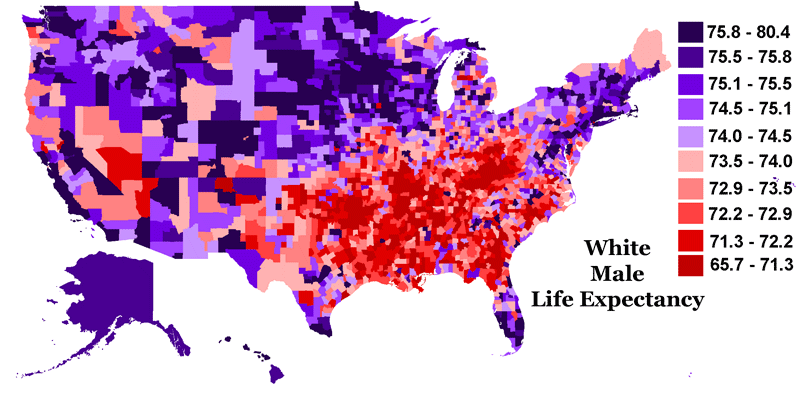
Why doesn't the South Support Health Care Reform?
Tuesday, July 14, 2009
Inventories

Tuesday, July 7, 2009
Opportunity Cost
Monday, July 6, 2009
Free Exchange's Interactive Graphic of the Day
1) if you just look at the first page of the thing, it's hilarious, because it's supposed to be about the economic situation and what it looks like is a three-year olds scribble. I could have stopped there and been delighted, but,
2) going through the interactive phases actually shows something informative (trust me), but you do have to be patient and look at what you're seeing carefully - industrial output and leading indicators.
Neato
Sunday, July 5, 2009
"Look" signs
First, the "yield to pedestrians" signs did was make less clear who had the right of way between a car on the street and a pedestrian who had not yet actually entered the crosswalk. Smart pedestrians will still pause when there is approaching traffic because her incentives are well-defined. But forgetting that relatively minor confusion, it created a Pelzman Effect and you would increasingly see dumb (sometimes intoxicated) undergrads wandering out into intersections without care, and sometimes talking on their cellphones.
U of I sent out surveys and I said then what I'll say now: They should have put up signs warning pedestrians to look both ways before entering the intersection. It's so simple we teach it to kindergartners. Anyway, they have such signs painted on the crosswalks in Vancouver (where I attended a conference last week) for pedestrians that say "LOOK ->." Maybe their health care system isn't what we want, but their attitude towards dummies who don't pay attention in traffic is admirable.
Friday, June 26, 2009
Flipping Bias
"But," you might say, "what if the coin's center of gravity is closer to the head side?" or "what if one edge is heavier?" or "what if it's slightly concave like a frisbee?" Still, the coin is not the source of any bias that results. As long as the coin does not bounce or roll after it lands, it has an equal chance of heads and tails (I've never observed a coin landing vertically on its edge but I won't completely rule it out!). Just think, a coin tossed with only "flipping" momentum spends 50% of it's time heads up, and 50% of it's time heads down. No bounce, no roll, no spin, no bias.
E.T. Jaynes is Professor of Physics (and, as it turns out teaches statistics to physics students) at Washington University in St. Louis. To illustrate, he used a pickle jar (to view this you need GSView for free or some other postscript file, *.ps, viewer), which is top-heavy and concave. Tossing it 100 times without spin, bounce or roll, he got results (p=0.54) that were not statistically different from 0.5 (z = 0.04/sqrt(0.5^2/100) = 0.8 --> P(z>0.8) = 0.424). He also tossed it to favor tails (allowing it to roll) and to favor heads (by appling rotational spin to it). When it was tossed in a way that made it roll, heads came up zero out of 100 trials, and when it was tossed with rotational spin, it came up heads 99 times.
So, the moral of the story is this. I've discussed before the notion of bias in flipping one versus two discs to determine the pull preceding an ultimate game. This tells us that the disc (uneven as it might be) is not biased unless the tosser applies bias. If the bias in the tosses is the same, then even is a dominant choice, even if the direction of the bias is unknown (but it should be known if you see the toss - will it spin or roll?). This can be proven as long as you know that the area of a square is more than the area of a rectangle with equal perimeter, i.e. it can be shown that p^2 + (1-p)^2 >= 2p(1-p), with equality only at p = 0.5. However, that point is now moot. If the tosser is not manipulating the toss, any single flip (heads or tails) and any double flip (odd or even) has "fair odds."
I'm convinced. Hope you are too.
Tuesday, June 23, 2009
Government's Net Worth?
US To Trade Gold Reserves For Cash Through Cash4Gold.com
What exactly is the net worth of the US Government? Yes, the deficit/debt are large, and should be reduced, but how much is the stuff lying around that belongs to the public (land, fighter jets, buildings, etc.) worth? Anyone know of a place to try to get a ballpark for this information?
Monday, June 22, 2009
The Income Distribution Argument
There's not much reason to believe that the financial costs will be too much higher in public-pay as they are in a private-pay system, at least not per-person. But a private, free-market system tells me that if I want 10,000 dollars of benefit, I pay 10,000 (actually, since these contracts are not usually "actuarially fair" it would be more like paying 10000 and getting 8 or 9 thousand). Same goes for everyone else. This is a very "fair" stystem in terms of "benefits received," i.e. what you put in is what you get out.
Unfortunately, there are a lot of people who don't have the dough for 10,000 of health insurance, and there might not be a lower-priced option they can afford. Besides, if there is, it might not cover a lot of things or have a really high deductible (in fact the deductible might be so high that if they ever got so sick that their costs ever required insurance, it might put those same folks into bankruptcy - 68 percent of all individual bankruptcies are heath care related - anyway, so why bother!). This adds to the dimensions of adverse selection and moral hazard typical to the insurance market. Another "fairness" metric is a person's "ability to pay." If a good has "merit" qualities, and some folks cannot afford even a minimal level of it then what you pay is could be indexed to what you earn. Everyone gets 10000 in benefits, but a rich person pays 15000 or more, and a poor person pays a 5-6000. But is it "fair?" Yes, in a manner of speaking, because if we agree that everyone "should" have 10000 in basic coverage, then we wouldn't expect a person earning just 15000 a year to pay 10000 of it to for health insurance. (N.B. At moments like this I almost wish I remembered the game-theory formal notational definitions of "fair" and "envy-free," as well as the proofs for why Walrasian (free-market) equilibria do not generally exhibit this property....almost.)
Here's where I think the income distribution question slips in. Basically, the fight is this: Republicans represent rich folks, and Democrats represent poor folks. Making health care universal will necessitate a higher burden on richer folksto provide a benefit for poorer folks who cannot afford it. The poorest already get medicaid. Median wages have fallen over the last 9 years. Private health care costs are rising. Households view health care as a necessity. Somthing's gotta give. I suspect that if the Bush economic record were more favorable to the middle quintile of the income distribution then the "get costs under control" rhetoric would have been more effective, but rising health costs coupled with falling middle-class incomes means most people are wise enough to know that cutting costs around the edges won't do much. So, let's look at a couple of the proposals:
1. Sort of the two-tiered "keep what you want if you like it" option. People happy with their stuff now get to keep it but you still pay a percentage of your income into the public system. Of course, they will have to help pay for the publicly funded option, so their costs will either go up, or their coverage will change (by moving into the public pool). Poor people could get covered even if they cannot pay for it themselves, or can only afford a small portion of the burden. This would be a little like the education system, which, of course, is not perfect either.
2. Fully public "single-payer" system. This abandons the private option, and everyone receives the same basic plan. However, payment is based on a percentage of your income, thus shifting the payment burden up the income distribution even farther.
3. "Tax Credits." Rich folks love this option. Being able to deduct health care from their taxable income is great for them for two reasons: one, they all purchase health care anyway; and two, they pay a higher marginal tax on the income they get to deduct. This option would actually be MORE regressive than the current system (and if you think the revenues to make up for the "credit" are growing on trees you're crazy!). Good God, if you believed the republicans you'd think that tax cuts are could discover a cure for AIDS and build moon colonies, but guess what? They won't insure more people.
4. Stay with what we have and try to curb costs. Either way cost-efficiency needs to be addressed. Pulling more people into the pool for normal coverage might cut some costs per-person, but might increase costs in the aggregate, so this might not be such a bad thing.
Unless you believe that health care is a merit good, there will probably continue to be 12-15% of the population uninsured, and a growing percentage who are underinsured.
Friday, June 19, 2009
Markets and Health Care
Sounds great, but that's problematic. People choosing whether or not to get health insurance might know somewhat more about their own health histories than the insurer does, and try to game the system. People who think they're healthy might try to go without health insurance, or maybe alternate their decision so that they get it one year and not the next and so on. (In fact, a lot of people do this with the optional vision or dental coverage in their current health plans.) This gaming of the system by "healthy" people would drive up the price of insurance for regular subscribers because the insurer would know that those people are less healthy on average (or have an informed guess to that effect). That's why as a compulsory subscriber to a group plan most folks "pay" (between themselves and the portion that their employers pay) about $10,000 for insurance, whereas the on the individual market prices run about 15,000. Also, when "healthy" non-subscribers get "unlucky" (which some inevitably will) their reliance on urgent care drives the costs up even more for everyone, including subscribers.Thus, since there is incomplete information, adverse selection, etc., markets don't do the job all that well.
The employer-based system we have now is pretty good, in the sense that it resolves most of the adverse-selection problem by pooling subscribers according to something roughly independent of the quality of their health (i.e. subscribing everyone according to where they work rather than whether they voluntarily enter the insurance market). This does reduce costs, but this system is flawed, too. It distorts labor markets (giving some firms an incentive to move operations to Canada, Mexico, or Asia) because health benefits can comprise up to 30% of the labor cost for some lower-skill occupations. Not only that, but if you can only find part-time work or lose your job, you become uninsured, too (or face the higher prices of the private insurance market discussed above). Mandates might resolve this (we do this for auto insurance, by the way), but people are afraid of this option because some folks are likely to not be able to afford the cost.
That sort of brings us to the current debate, which is more about income distribution than anything else. It represents the classic trade-off between equity and efficiency in drawing up economic policy. It also brings the issue of "public goods" and "merit goods" into the debate. While there is little argument that health care is really a "public good," it may be a "merit good." I'll think about the distributional effects of "reform" tomorrow.
Thursday, June 18, 2009
Trust the Producer?
Point 1: The market for health care is one that is inherently prone to imperfect information. In some ways, patients know more about their health and their habits, but doctors know more about their diagnosis and treatment. In fact, doctors specialize in knowing more about things that are wrong with you, so we really don't wand to correct the problem by making patients 100% informed (that would be prohibitively costly). There needs to be some sort of external regulator here.
Point 2: Health care is already rationed by bureaucrats, and we wouldn't have it any other way. Private insurance has armies of bureaucrats that determine what types of procedures and what costs will be approved for your care, not your doctor. If they didn't do this, you wouldn't be able to afford health care.
Point 3: Lots of people have public insurance already, and actually prefer it to being thrown out on the market for private insurance. Most people who are eligible for Medicare, VA benefits, or TriCare (and do not have any employer-provided benefits) happily take these benefits. Even the bureaucracy doesn't seem to bother them that much. In fact a lot of the most expensive patients in the system are already paid for using tax dollars.
Point 4: Private insurance is much more costly per person than being part of a group plan because insurees in the private individual market are adversely selected. Mostly sick people choose to be insured in this corner of the market. Healthy people in this part of the market who don't have insurance sometimes get very unlucky all of a sudden, and their urgent-care costs drive up costs for others.
Point 5: Private insurance premiums are not "actuarially fair" in economic terms. In other words, the premium i pay them exceeds the total expected cost of providing care over the entire pool of insurees. In other words, insurance companies make "economic profit," which should be distinguished from "accounting profit," or "proprietors' income."
I'm not sure if single-payer is the way to go, but the total net cost probably won't go up too much. If you think of the labor cost your employer pays in health insurance as wages you're not getting, it's outrageous! Between my employer and myself, I already pay about $10,000 per year! If that money simply shifted from my BC/BS to the government, and I got a comparable level of care, what does it matter? Bottom line: it's not patients and doctors who decide things now. Bureaucrats already decide and will continue to do so regardless.