follow us in feedly

Wednesday, October 28, 2009

Split or Steal

Lesson: Don't trust anyone who's been stabbed in the back before (especially if you're the one who did it).


Wednesday, October 21, 2009

Why 3d Graphs are usually misleading

Just because you can do it in Excel doesn't mean it's the right way to do it. Below, the author has made a graph of the number of Starbucks over time. The height of the cylindrical columns is increasing, but so is the width, making it seem (visually) as if the increase has been all the more gruesome.


Sunday, October 18, 2009

Will and Krugman

Was fun to watch George Will & Paul Krugman bristle while trying not to interrupt the other on ABC this morning. Will was looking down and tapping his fingers nervously at Krugman, then Krugman looked like he was about to rip of his own beard while Will decried the possibility that the Chinese would own our debt. PK's argument was that that's not how they were going to pay for it. The bigger question is, if the Chinese buy US bonds to finance health care, for whom is that worse in the long run? If inflation shoots up and the dollar crashes (like GW himself has predicted) this would clearly ruin the Chinese!

Friday, October 16, 2009

Should OPEC be Compensated?

Economically, there is no argument for giving oil exporters a handout to compensate for our ability to reduce our own demand, thus driving down the price. Remember, they don't give us a kickback for all of their supply-reducing behavior that drives up the price. But, there might be some political reasons to make such a side-payment.

Carbon Tariffs

From Matt Yglesias a few days ago:
The EU, Canada, and Japan are in the aggregate much more significant trade
partners than China/Mexico/Brazil. And the case for them charging us carbon
tariffs seems about as good as the case for us charging the Chinese.
I think we're missing the bigger issue: Why a carbon tariff? Why not just a tax on carbon content for domestically and foreign produced goods? Why give domestic producers a "carbon subsidy?"

Thursday, October 15, 2009

Sad Commentary

This post is not related to VMI per se, just a small part of the article revealing a sad fact about society:
Last year, the U.S. Justice Department began investigating whether VMI's environment is especially hostile to women. Allegations of sexual assault have become a fact of VMI life, occurring about once a year, typical for a school of this size, according to college officials. The first case to result in a criminal charge ended Tuesday.

In that case, a female cadet alleged that Stephen J. Lloyd, then a senior from Mason Neck, Va., pulled her into a storage room the night of March 27 and raped her. Lloyd no longer attends VMI. On Tuesday, he entered an Alford plea, which means he did not admit guilt but acknowledged that there is enough evidence to convict him. The plea is tantamount to a conviction of misdemeanor sexual battery.

The sentence: a year in jail and a $2,500 fine, suspended.

That means they guy could have easily been convicted, but instead got a suspended sentence, meaning he will not serve a day for rape. Probably happens all the time all across the country, and that is a sad commentary on our society.

Wednesday, October 14, 2009

Milestones

The dow closed over 10,000 today. What does it mean? Nothing, really, but maybe it helps psychologically.

Tuesday, October 13, 2009

Lurking Variables and Statistical Literacy

People are squealing about pork and the payrolls for federal employees. Fact: Federal employees make more on average than private-sector employees. Fact: They are not overpaid.
Economix explains why:
In 2008, only 14 percent of federal workers were on part-time schedules, compared to 26 percent in the private sector. Federal workers were far older on average: 55 percent were between the ages of 45 and 64, compared to 36 percent of private-sector workers. Furthermore, 45 percent of federal workers held a college degree or higher educational credential, compared to 29 percent of private-sector workers.
and
analysis of the impact of individual education and experience on earnings in the United States by the Harvard economist George Borjas showed that federal employees are paid considerably less than comparable private workers at the top end.
Basically, people looking at the simple averages are not accounting for several important ("lurking") variables that more than explain the average differentials between federal employees and the average private-sector employee.  Andrew Gelman calls this a lack of "statistical literacy"; some call it "lying with statistics". These statistical liars include Chris Edwards at Cato (who by the way should probably know better but is advancing a deliberate agenda), The Free Enterprise Nation, Ilana Mercer of World Net Daily, and Jeff Jacoby of The Boston Globe.


Monday, October 12, 2009

The Prize

The prize in economics went to Ostrom and Williamson for institutional economics.
“In reading [Professor Ostrom's and Williamson's] work, you are
impressed that economics is not really fundamentally about markets, but
about resource allocation and distribution problems
. Markets appear
because they operate effectively to handle a subset of these resource allocation
challenges.
” - Michael Spence, senior fellow, the Hoover Institution.

A timely reminder to those who are following the current crisis.

Sunday, October 11, 2009

Protons, Prostate Cancer, and Bad Incentives in Health Care

Here, and here. If you have 3 options of equal impact, one that is free, one that is $50,000, and one that is $100,000, why is it that our current system picks the third one? Answer: it's hard to convince most people that more health care is not equivalent to better health care. Most people think "proton radiation therapy" sounds like it will do more good than "wait and watch." It doesn't.
I'm still puzzled by the blind faith we put in doctors when it comes to their motives in recommending treatment. Doctors, like mechanics, have an incentive to "run up the bill" even to the point of making s--- up or recommending treatments (repairs) that may or may not be necessary. We should WANT a bureaucrat that knows something about the effectiveness of treatments between us and our doctors, whether it's a government bureaucrat or a private sector one! Problem now is that the private sector bureaucrat has perverse incentives, too. A little regulation in these cases (or a public provider) could go a long way.

Saturday, October 10, 2009

Thursday, October 8, 2009

The Downside of a Global Supply Chain

Mmmmm beef parts. Still damn tasty.
Ground beef is usually not simply a chunk of meat run through a grinder. Instead, records and interviews show, a single portion of hamburger meat is often an amalgam of various grades of meat from different parts of cows and even from different slaughterhouses.... The frozen hamburgers made by the food giant Cargill, were labeled “American Chef’s Selection Angus Beef Patties.” Yet confidential grinding logs and other Cargill records show that the hamburgers were made from a mix of slaughterhouse trimmings and a mash-like product derived from scraps that were ground together at a plant in Wisconsin. The ingredients came from slaughterhouses in Nebraska, Texas and Uruguay, and from a South Dakota company... Those low-grade ingredients are cut from areas of the cow that are more likely to have had contact with feces, which carries E. coli, industry research shows. Yet Cargill, like most meat companies, relies on its suppliers to check for the bacteria and does its own testing only after the ingredients are ground together.

Wednesday, October 7, 2009

Order Matters

Most polls have health care reform in its currently proposed form at about 43% for/45% against. Fox News has it at 35% for/49% against. Something's fishy, but the sampling was fine and so was the overall wording of the question. It was the questions that preceded the health care question that may have biased the attitudes of the respondents. See more at fivethirtyeight.com

Tuesday, October 6, 2009

Chessboxing

Here. Maybe my students could think of a joke relating to a full-contact statistics exam.

Saturday, October 3, 2009

"Locavorism" and the Environment

"Buying local" is not necessarily buying green:
...lamb raised on New Zealand’s clover-choked pastures and shipped 11,000 miles by boat to Britain produced 1,520 pounds of carbon dioxide emissions per ton while British lamb produced 6,280 pounds of carbon dioxide per ton, in part because poorer British pastures force farmers to use feed. In other words, it is four times more energy-efficient for Londoners to buy lamb imported from the other side of the world than to buy it from a producer in their backyard.
Nor is knowing the producer necessarily good for the community:
Historically, such personalized economic transactions were the norm, but they were inherently fraught with risk and tension. In colonial America — a place I’ve studied in some depth — all markets were initially driven by face-to-face interaction. It should come as no surprise that things could get, well, personal. Markets were intensely competitive and exclusive. Everyone knew everyone. And that was often the problem. The court records of colonial New England are replete with personal market transactions gone awry.
Food for thought, so to speak. Trade is good.

Thursday, October 1, 2009

Bayes' Rule and Dick Cheney's One Percent Doctrine

I was teaching Bayes' Rule this week, and there's an example that has to do with lie detectors and stealing. The story is that you have employees, of whom 10% are stealing. You also have a lie detector that is 80% effective (i.e. P(positive test given stealing) is 0.8 and P(positive test given not stealing) is 0.2, etc.). So, if you apply Bayes' Rule, you learn that given a positive test (i.e. the lie detector says you are lying/stealing) is just 0.308!
So, what about Cheney's "One Percent Doctrine" for justifying torture? Even worse! Let's suppose that there is a 1% chance that a detainee has information about a terror attack. Now suppose that torture is 90% effective in the sense that if that detainee is conspiring with terrorists he "confesses" and gives information about it with probability 0.9, but also confesses (with whatever made-up details he can think of) with probability 0.1 if he is innocent. (This, I think, is being generous to the effectiveness of torture!) Then, GIVEN a confession, the probability that there was really a plot is just 0.009/(0.009+0.099) = 0.083 - less than 10%!
The conclusion here is that the one percent doctrine logically fails when there is even a small chance of getting false positives from your intelligence-gathering resources and methods. It seems from what you hear that torture leads to sufficiently many false positives that it probably isn't helping, and is probably HURTING our security by leading our enforcement agencies on wild goose chases! Food for thought!

Made up Statistics

Nate Silver accuses Strategic Vision of cooking its books on poll "data" it releases.

Alex Tabarrok Tells Reiterates all the Good Stuff about Globalization

Another Ted.


Intrinsic Motivation vs. Extrinsic Motivation (a.k.a. "Incentives")

From Ted Talks.

More Financial Innovation that Doesn't Suck

For the last couple of years unbanked Kenyans have been using their mobile phones as mobile banks, which has proved invaluable as a means for small savings and remittance transfers for poor households.

Wednesday, September 30, 2009

Sunday, September 27, 2009

On the Wages of Clergy and Accountants

Cap and Trade Basics

If you care to be informed about the impact of cap and trade, read this. Here are the important points:
1. Think of the benefits to the private sector from pollution. ... it’s cheaper ... to produce goods if you don’t worry about whatever emissions result as a byproduct.
2. A cap-and-trade system puts a limit on overall emissions, so that emitters have to pay a price for emitting.
3. The cost to the economy of this limit is the benefit the private sector would have gotten by emitting more than is allowed under the cap.
4. The creation of cap and trade means that emission permits command a market price, and the value of these permits ... (a growing fraction over time) would be captured by the government through auctions, and ... in effect, recycled to consumers.
A couple of notes for those who don't want to read the original: 1. the costs in (3) are not very big - they are a deadweight loss triangle, not the total market value of the permits (which is what some guesstimates of the costs say); 2. the current and future environmental benefits of the cap may or may not outweigh the losses to firms; 3. assuming that the "cap" does a good job of balancing firms' losses with environmental gains, an auction is more efficient than a Pigouvian carbon tax which is more efficient than the current system of "cap and regulate," which is in turn more efficient than subsidizing emission-reducing investments (*see below); and 3. the effectiveness or fairness of how the government is able or willing to "recycle to consumers" the revenues generated is something we can have a fair debate about.
* Note on policy options: Cap and trade and a carbon tax both have the advantage of allowing the firms for whom it is most expensive to cut emissions to emit more if they are willing to pay, whereas those for whom it is least expensive have an incentive to make more cuts. Firm-by-firm regulations do not achieve this, and subsidies have the unintended long run side-effect of leading to higher consumption of the very things whose production results in emissions. In theory, an auction does a better job of "getting the price right" for a given desired quantity. One thing that might tilt in favor of a tax over an auction would be setup costs - designing an auction that gets the price right is a difficult problem in theory and in practice.

Using Derivatives for Good Instead of Evil

This excerpt Robert Pozen's "Too Big to Save? How to fix the US Financial System" points to a good use for derivatives (HT: Marginal Revolution):
The Danish model has another critical and innovative feature.  Holders can retire their own mortgages by purchasing the same face amount of mortgage bonds at the prevailing market price.  To prepay a mortgage by purchasing bonds, the home owner must give advance notice of several weeks to the MCI [mortgage credit institutions], which designates by lottery the specific bonds to be purchased.  Thus, if rising interest rates or other factors cause mortgage bonds to trade at a discount, home owners can reduce the principal or retire the whole mortgage by purchasing an appropriate mortgage bond at a discount.
This is an example of innovation that would make markets more robust help prevent foreclosures, rather than the types of innovations we've seen in the US, which are mostly meant to subvert regulations. The fact that this has not evolved in the US makes me think two things: One, that the balance of power IS tilted in favor of banks and against the consumer (maybe due to lobbying power, which Adam Smith and other "classical" market economists warned against); and two, that the regulatory framework has created some degree of moral hazard and/or regulatory capture (i.e. banks are taking risks and doing things way beyond what they would normally do because they do not face consequences from the market, i.e. bailouts, or the regulators, i.e. bureaucratic corruption) over the last 30 years.

Thursday, September 24, 2009

Fossil Fuel Subsidies

This graph from David Roberts is somewhat misleading (for example, it's hard to tell if magnitude is measured as radius from the origin or total area and I'd like to see a breakdown per BTU or something), but it has a powerful point: We subsidize "dirty energy" more than we subsidize "clean energy" in the aggregate. Why not, before getting into a big brew-ha-ha over cap-and-trade, remove the implicit and explicit subsidies for making the environment worse-off?


Wednesday, September 23, 2009

Incentive to Die?

I remember a humorous story from Parentonomics about a policy in
Australia (which had been facing unusually low population growth) that
awarded new parents a couple thousand bucks to have a kid during a
specified period (let's say ending June 30 because I can't remember the
exact dates). Well, the story went, there were an unusually large
number of births on during the last week of June that year, and
especially on June 30 (along with a correspondingly low number during
the first few days of July). There were lots of theories about this,
including: (1) fraud, getting doctors to put June 30 for a baby born on
July 1; and (2) inducements and/or cesarian sections scheduled before
the deadline.
Bush (W, not HW) put through a law that would
decrease and eliminate the estate tax by 2010, but with a rebound to
pre-Bush levels in 2011. How did no one accuse Bush of creating a death
panel?!? Wouldn't this promote some combination of fraud or worse,
euthanasia? Part of me says, "Let's leave it that way and see what
happens - it would be a neat experiment on the limits of tax
evasiveness," but that wouldn't be ethical. Instead, something needs to
be done to either make sure it is slowly phased back in, or not
reintroduced depending on your political fancy.

Sleep in the Age of Rational Expectations

From MR:
Lately I've developed a new theory as to when I sleep especially well (in general I sleep well so the variance is not so large).  I believe that I sleep especially well when I end up going to bed at exactly the same time I expect to be going to bed.  On the unusual occasions when I don't sleep well, it is because I have been winding down my body and mind before I actually have the opportunity to fall asleep.  Somehow when the later chance to sleep comes, it is too late for that sleep to be deep.  Or so it seems to my mental econometrics; it would be interesting to measure it.
Interesting, yes. Testable? Hmmm.

Monday, September 21, 2009

Thank you Captain Obvious (Ron Jaworski)

"They [the Dolphins] don't want any negative plays under Coach
Speranno." As opposed to all those previous coaches who were
strategically trying to lose yardage?

Sunday, September 20, 2009

Faith-Based Uncertainty?

From Regent University's graduate course catalog (p. 226):
GOV 601 Quantitative Analysis (3) Skills for quantitative data gathering, measurement, policy analysis and program evaluation. Research and sampling design, surveys, data collection and data reduction and display. Review of basic statistics through multivariate analysis, z-scores, regression through the use of statistical computer package (SPSS), and a Judeo-Christian perspective on the use of statistics.
What? HT: AG.


Just a Boring Note on Sampling....

From Nate Silver at 538.com:
...[T]he Investors' Business Daily poll purporting to show widespread opposition to health care reform among doctors is simply not credible. There are five reasons why:
1. The survey was conducted by mail, which is unusual.
2. At least one of the questions is blatantly biased: "Do you believe the government can cover 47 million more people and it will cost less money and the quality of care will be better?"
3. ...The IBD/TIPP polling operation has literally no idea what they're doing. ... For example, I don't trust IBD/TIPP to have ... selected ... a random panel, which is harder to do than you'd think.
4. They say, somewhat ambiguously: "Responses are still coming in." ... Professional pollsters generally do not report results before the survey period is compete.
5. There is virtually no disclosure about methodology.


Friday, September 18, 2009

A Brander & Spencer Style Strategic Trade Prisoner's Dilemma

From the Economist:
Elsewhere, the story points out that not a single manufacturer of any
significant size has gone under during the recession. There is a serious problem
here. No government wants its national champion (or champions) to be the one
that goes under, and so governments provide such support as is needed to pull
companies through tough periods.

Oligopoly, subsidies and trade. I question, however whether subsidies are the best strategic policy. If the nature of competition is Bertrand-style price competition, then export subsidies can improve domestic welfare (assuming no retaliation - heroic!). If the nature of competition is Cournot-style quantity competition, then tariffs and/or export taxes are appropriate in the absence of retaliation. Export taxes have the same proportional impact on relative prices as import tariffs; subsidies do the opposite, and worsen the terms of trade (price ratio of exports to imports) of the country offering them.

Thursday, September 17, 2009

Does this Recession Make the World Look Fat?

In 2005 Thomas Friedman declared the world flat, but I always liked Ed Leamer's review in JEL, which points out the fact that it's a strange, and perhaps inapt analogy (he also makes pokes fun with some very esoteric "jokes" about different notions of what "flat" might mean, but that's besides the point). A new historical view by David Jacks (HT: Economix) shows us how the late 20th century decline in trade costs (and increases in trade) pales in comparison to those of the late 19th century (something I've observed in my undergrad classes already by the way!). Anyway, trade is down by greater proportions than those observed during the Great Depression and everyone has their culprit of choice. Some talk about oil prices (although I'm not sure that in real terms oil and fuel is all that much more expensive now than it was in the late 1990s); some blame a general downturn (although I'm pretty sure the downturn in the G.D. was much greater, without even checking the data); and others put it on governments and protectionism (although this too has been tame compared with the Depression Era).
The answer to me is twofold: (1) 1990s globalization centered on growth in components; and (2) trade is not a value-added concept like output is. For the first, the basic idea is that instead of countries specializing and producing all of certain finished goods that are consumed by end users, the recent explosion in trade was in components - countries specialized in a particular part of the finished good. Since trade is not a value-added concept, so within this integrated supply chain, you can have the value-added of a 20,000 dollar auto counted many times - the steel ($5,000) gets shipped from China to 3 other countries where components are made (at, say, $2,000 of value added in GDP per country), then to Mexico for assembly (another $4,000), then managerial, transportation marketing services by the US (for about another $3,000), and sold in Canada for $20,000 (the retailer's value-added is $1,000). If this car disappears from world trade, it amounts to a reduction of world GDP of exactly $20,000 because GDP only counts value-added. However, trade (imports plus exports is a common measure) is reduced by $(5,000 + 11,000 + 15,000 + 19,000)x2 = $80,000 due to the multiple counting of the total value at each stage of shipping instead of only counting each country's value-added.
So, the world is not getting fat (it's approximately as flat as it was last year) and I'm neither shocked nor alarmed at the decline in trade (at least, no more shocked or alarmed than I am about the decline in output generally).

Grad School?


So, why did I go through all that again? Oh yeah. The "job satisfaction."

Tuesday, September 15, 2009

Do Deficits Matter

Today, Becker writes:
To the extent that the source of the rise in a deficit is increased government
spending, then whether that rise is justified depends on how socially valuable
are these government expenditures. By that I mean the social rates of return on
these expenditures, such as longer lives for the elderly, relative to the
interest cost of raising the required funds, and relative to the returns on
other investments in the economy.

So, on this principle, if you have a trillion dollars to spend, would you spend it on 5 years of war in Iraq or 10 years of universal health care?

Economists' Views

Things Economists Agree on according to this article:
Agree Strongly Agree
NeutralDisagree Strongly Disagree
Hetero-geneity Index
The U.S. should allow payments to organ donors
15.60%14.10%70.30%0.5384
A Wal-Mart store generates more benefits than costs.14.60%13.10%72.30%0.5612
Employers should be rq'd to provide all employees health insurance71.70%7.90%20.40%0.5619
The U.S. should ban genetically modified crops.
82.10%10.90%7.00%0.6908
The U.S. should eliminate remaining barriers to trade.9.80%6.80%83.30%0.7081
Economic growth in developed countries increases well-being2.30%9.80%87.80%0.7810

What they don't agree on:
Sarbanes-Oxley should be repealed.
47.40%27.60%25.00%0.3634
U.S. should eliminate the mortgage interest deduction. 38.00%16.30%45.70%0.3798
U.S. should increase benefits to workers who lose jobs due to int'l comp.
27.70%20.80%51.50%0.3852
Health insurance benefits should be taxed the same as income. 44.50%13.50%42.10%0.3935
The U.S. should place more stringent caps on medical malpractice awards.32.10%16.40%51.60%0.3962
States should eliminate mandates about what health insurance must cover. 45.60%12.00%42.40%0.4021

On the Probability of Acceptance

There was a certain professor at Illinois (who is no longer there) who once claimed, "Adding an integral sign to a paper will unambiguously increase the probability of acceptance." This confession of an economist offers more proof. The author revised a clear and simple paper (which, by the way, had been rejected) into an incomprehensible mathematical maze of equations and proofs (which, of course, was accepted by the very same journal that had rejected the clearer, simpler version). Sad, but true.

Thursday, September 10, 2009

Overbetting Longshots

HT: Andrew Gelman (link to the ref here)
we find evidence in favor of the view that misperceptions of probability drive the favorite-longshot bias, as suggested by Prospect Theory
I.e. it's not a love of risk in the utility functions of gamblers, it's statistical illiteracy. They can't figure out that a 29:1 longshot has at best a 1/30 probability of winning (if the odds are "fair").
One problem I have is that, to Gelman and others this research contradicts theories of rational choice. Not so. It suggests that people are either (a) poorly informed; or (b) process information poorly. To quote a Larry Summers finance paper, “THERE ARE IDIOTS. Look around.”
Go Chiefs!

Line of the day

From a story in the Post on the decline of grass-fed cattle in
Argentina and the rise of feedlots.
One argument against feedlots is
that it is unnatural. The other side:
"What's natural is for a cow to grow, to reproduce and to die."
Fun stuff.

Stumbling Blocks or Building Blocks

While bilateral trade deals are increasing trade amongst countries in regions with lots of bilateral deals has not. Furthermore,
Countries may worry that a multilateral deal would erode the preferential terms they got through bilateral ones. If so, the flurry of bilateral deals may have come at the expense of a world trade agreement. Gary Hufbauer of the Peterson Institute of International Economics in Washington, DC, thinks that China and India have decided they would “rather pursue bilateral FTAs than make the necessary concessions to push Doha across the finish line.”
This is more disturbing than any specific national protectionist policies because it undermines the WTO, the MFN principle, and multilateralism.


Tuesday, September 8, 2009

NFL Rankings

by Me.
  1. 1.Titans
  2. 2.Vikings
  3. 3.Steelers
  4. 4.Saints
  5. 5.Giants
  6. 6.Chargers
  7. 7.Patriots
  8. 8.Colts
  9. 9.Falcons
  10. 10.Texans
  11. 11.Bears
  12. 12.Eagles
  13. 13.Dolphins
  14. 14.Packers
  15. 15.Buccaneers
  16. 16.Jaguars
  17. 17.Cardinals
  18. 18.Panthers
  19. 19.Cowboys
  20. 20.Redskins
  21. 21.49ers
  22. 22.Ravens
  23. 23.Bills
  24. 24.Seahawks
  25. 25.Bengals
  26. 26.Broncos
  27. 27.Jets
  28. 28.Rams
  29. 29.Chiefs
  30. 30.Browns
  31. 31.Lions
  32. 32.Raiders
Don't hold me to this. I figure if I set the bar low for the Chiefs, they are unlikely to disappoint.

The office kid

Markets in everything via MR: The office kid. It's an idea sprung by office workers thinking they were getting screwed into more work by people with kids (who were always having to leave for kid-related problems). The idea was to have a fake kid so you could get your share of paid time out of the office.

I have a better idea. Instead of cooking up a scam, organize the market so the single workers get paid to "take their turn" getting "time off" for dealing with their coworkers' kid-related problems.

Our Portfolio of Imperfect Institutions

Markets, nonmarket institutions, and governments. From Economix:

First, a large share of our economic output is now produced by large companies whose sales exceed the gross domestic product of many countries of the world. The vertically integrated supply chains of these large, often bureaucratic institutions seldom involve markets....

Second, market output represents a subset of total economic output. ...time and energy to caring for ourselves, our families and our friends ... activities that improve our own living standards ... men now devote more time to housework and child care than they once did. As we move toward more equitable sharing of unpaid work, policies designed to help wage earners meet their family responsibilities ... seem expensive to us in part because we have taken women’s unpaid work for granted in the past.

Third, the present and future costs of environmental degradation are on the rise.

Markets aren’t the only imperfect institutions in our world. Governments, families and Mother Nature are also susceptible to failure.

The point is, like it or not, we rely on a portfolio of imperfect institutions — a mixed economy.

Silly Anti-Reagan Conservative Health Care Protesters

From MR via The Beacon. Just say no.


Monday, September 7, 2009

More Economist Humor

This came via Phil at Market Power:

Reminds me of the old Woody Allen line, "Those who can't do, teach. Those who can't teach teach gym."

Sentence of the Day

Tyler Cowen, answering the question, "What is Conservatism?"
Responsibility is a more important value than either liberty or equality.
The whole post is worth reading but that point (the last) is the keenest.


Friday, September 4, 2009

Damn Imported Bald Eagles

It's a sad day when the US has to import bald eagles... or a happy one that there is an abundance somewhere else that allows us to!

More on the similarities between Presidents Obama and...

Nixon?

Yup, I've covered it before: Nixon was a self-proclaimed Keynesian; Nixon proposed a "negative tax" that would effectively reform welfare and still help the poor. Now, I've seen it all. Nixon favored a national health program that offered universal coverage. Here's proof. The principles of it:
First, it offers every American an opportunity to obtain a balanced,
comprehensive range of health insurance benefits;
Second, it will cost no American more than he can afford to pay;
Third, it builds on the strength and diversity of our existing public and
private systems of health financing and harmonizes them into an overall system;
Fourth, it uses public funds only where needed and requires no new Federal
taxes;
Fifth, it would maintain freedom of choice by patients and ensure that
doctors work for their patient, not for the Federal Government.
Sixth, it encourages more effective use of our health care resources;
And finally, it is organized so that all parties would have a direct stake
in making the system work--consumer, provider, insurer, State governments and
the Federal Government.

If Tricky Dick were running for his old senate seat today, he'd probably either have to run as a democrat, or he'd lose in the primary to someone who has no shame in calling him a socialist. Interesting how the political tides in the Republicanist party have shifted to the extreme.

The Consumption Bubble

Thursday, September 3, 2009

More on the benefits of globalization

Economic History and the Variety Gains from Trade

Free Exchange highlights this from a new VOX paper on economic history and pre-industrial revolution welfare improvements:

Tea reached Europe from China in 1606, spreading to France in 1630, and finally to England in 1650...Coffee spread through the Middle East and arrived in Europe in 1615. Sugar, available before 1500 in limited quantities, only became affordable once production centres developed in the Caribbean starting in the mid 17th century.

By the end of the period, sugar, coffee, and tea constituted 7.2% of an average English household’s budget, and roughly 10% of their food expenditure...To put this in perspective, personal consumption expenditure on personal computers in the US in 2004 was only 0.6% of consumption expenditure, meaning that, by at least one metric, the average Englishman valued sugar more than the average American values his or her computer...

Prior to 1700, the average European consumed 182 kg of bread and 182 litres of beer per year...Half of all spending was on beer and bread, and fully three-quarters of all calories came from these two sources alone. The reason for massive beer consumption was simple – water was often contaminated. This was especially true in the cities. Brewed beer was safe. It is hence not surprising that it was consumed throughout the day, often with breakfast, and in all forms – including as beer soup in the morning...

Minivans, satellite TV, the internet, and mobile phones have made life better. The single biggest addition to welfare comes from the introduction of personal computers, credited by Greenwood and Kopecky with a gain of 3.5-4% of consumption expenditure. Compared to these figures, the gains for coffee, tea, and sugar look very large.

The thing to highlight here is the importance of TRADE. Without expanding trade, it is doubtful that tea, coffee, and sugar could have ever become available. Hence, variety gains from trade. It only took until 1980 for Krugman to formalize it in the trade literature.


Wednesday, September 2, 2009

Some Links

Not much time to talk about these, but they're interesting:
Bayesian analysis of support for school vouchers; it would be interesting to see for health care.
When supply is low, the price is high: Womens' attitudes towards monogamy and the relative supply of marriagable men.
Probability is the oil of rationalization: "To rationalise a choice you want to make, you choose costs and benefits that lead to your choice seeming like the rational conclusion."
And to complement the previous: Ice versus soda cost-benefit analysis.

Tuesday, September 1, 2009

Saturday, August 29, 2009

Pythagoras's Student

Interesting anecdote of the first known proof of the existence of irrational numbers.
I have to think today, instead of putting Hippasus to death, Pythogoras would have stolen the proof and claimed it for himself.

Hippie Deoderant

I almost feel like trying this out of curiosity.

Cheating goes Bionic

My first thought on seeing this: And I thought cellphones and blackberries facilitated cheating!

Tuesday, August 18, 2009

Gambling Statistics "Fun" Problems

Secondary Environmental Impact of "Cash For Clunkers"

The main, primary effect of C4C is positive, but since the traded-in cars are scrapped, not sold in developing countries (for even higher-emission vehicles) is the environment help trumped (somewhat) by restricting trade in the used car market (by requiring the vehicles to be scrapped?

Bigshots on Financial Innovation

Sampling and Newsertainment Polls Dymystified

The Daily Show With Jon StewartMon - Thurs 11p / 10c
Poll Bearers
www.thedailyshow.com
Daily Show
Full Episodes
Political HumorSpinal Tap Performance


For those who are interested, here's a link to the equally-funny "moment of zen..."

Best "Moment of Zen" Ever

This is from a ways back, but when it came up as a suggestion after watching clips from last night, I was reminded of its comedic beauty.

The Daily Show With Jon StewartMon - Thurs 11p / 10c
Moment of Zen - Coulter Sells More Books
www.thedailyshow.com
Daily Show
Full Episodes
Political HumorSpinal Tap Performance

Monday, August 17, 2009

Sunday, August 16, 2009

Question about the housing bubble/financial crisis.

If the housing bubble and financial crisis can be attributed to a small incentive to give a small percentage of home loans to poor borrowers in the US, why did UK and Germany have bubbles and crashes, too, and why did UBS and RBS have their own subprime crises? I mean it seems like an obvious way to debunk the "deregulation and 'innovation' were great it was the liberals' fault for trying to help poor people."

Friday, August 14, 2009

Krugman's Pants

Ever wonder if the talking heads are wearing pants below the pan of the camera? This is Paul Krugman today before appearing on MSNBC. He posted it on his blog.


Thursday, August 13, 2009

The usefulness of Venn Diagrams

A couple weeks ago at tennis, one of the people I had the pleasure to
lose to (who teaches junior high math) mocked the usefulness of Venn
Diagrams. Of course, they're pretty useful to illustrate logical
relationships, and according to Nate Silver at 538, Mr. Huckabee could have used them this past spring.  

Conspiracies and Economic Statistics

Menzie Chinn at EconBrowser writes,
In my view, the reason why so many hold onto these views is because it's so much easier to remain ignorant, and leap to the conspiracy view, than to do the hard work to understand why the statistics are imprecise measures of economic concepts, and why they are revised over time. After all, the former requires nothing more than taking somebody's word, the latter entails reading the supporting documentation, comprehending what the terms used mean, and applying some basic math and statistics skills...
In other words the reason conspiracy theories attract a nice crowd of supporters is because people are "rationally ignorant." Being informed takes a lot of effort, and it's easy to believe a plausible lie (along with a dose of paranoia that the other side is lying) than it is to be bothered with the facts.


Wednesday, August 12, 2009

Interesting Happiness Map

From Gallup, the well-being index has a map tool where the colors represent the quintiles of the distribution of states, districts, etc. Personally, I think the congressional district option is more informative because congressional districts are a little more closely normalized by population than states as a whole (and thus the quintiles are more meaningful, I think).

Pot is a NORML good

A normal good is a good whose demand increases with income. Here is the correlation between pot use and per capita gross state product (GSP).

Better Bones

More fun health information.

What?

Sauna is a competitive sport?

Improving Math Skills

Free Exchange cites new research showing better math skills lead to about a 15% increase in wages of black males since changes were made to required curricula. The theory is that there were high margins for gain for black students because their access to basic math classes had been limited. Great. So let's get more teachers and teach more math at advanced levels. Not so simple. Many high school math teachers did not even earn a minor in math at the bachelor's level. Why? Precisely because people with a quantitative degree (and are thus qualified to teach math) can earn higher wages! Those with math degrees (and minors) are busy doing things that earn better money than the parity negotiated by the teachers union. If we could do more in the secondary level to have market-based differentials between math teachers and teachers in fields with less lucrative outside options, then the math teachers we do end up with might be better qualified.

Monday, August 10, 2009

Change the "Price"

I'm pretty sure if people had to give up something to get into a town hall meeting, you'd easily be able to weed out riffraff who don't want to actually gain information from the discussion. Now, it might be unreasonable to charge money for access (although I wouldn't oppose it), but what if you simply told people to fill out a form with their name and address, and show valid ID? Would that raise the "price" enough to bring some civility to the debate, and maybe tone down volume of the misinformation?

A lot of comparisons are out there, by the way, with anti war protests and their rancor. In a way, that's true, but those protesters generally kept their protests to the streets - they were seldom allowed into the "meetings" or "discussions" Bush and other Republicans held to preach to their base.

Friday, August 7, 2009

Stop picking on the USPS

Tyler Cowen on Progressivism

I'd suggest looking at all 11 points in favor of the idea, bearing in mind the second-to-last paragraph: "In due time I'll be writing more systematically about why those views are not, on the whole, my own. But not today!" I particularly like #6 and #8.
6. Limiting inequality will do more to check bad governance than will the quixotic libertarian attempt to limit the size of government.
8. We should support free trade, more immigration, and more foreign aid, but the nation-state will remain the fundamental locus for redistribution. That means helping the poor at home more than abroad; a decision to do otherwise would destroy political equilibrium and make everyone worse off.

Dr. Cowen is generally a skeptic of government interventions, so it will be interesting to see his critiques.

Mark Thoma on Economic Models

A map has always been a principles-level analogy for why models are useful. Mark Thoma gives us a nice twist on it:
But all the tools in the world are useless if we lack the imagination needed to build the right models. Models are built to answer specific questions. When a theorist builds a model, it is an attempt to highlight the features of the world the theorist believes are the most important for the question at hand. For example, a map is a model of the real world, and sometimes I want a road map to help me find my way to my destination, but other times I might need a map showing crop production, or a map showing underground pipes and electrical lines. It all depends on the question I want to answer. If we try to make one map that answers every possible question we could ever ask of maps, it would be so cluttered with detail it would be useless, so we necessarily abstract from real world detail in order to highlight the essential elements needed to answer the question we have posed. The same is true for macroeconomic models.
I may have to use that in class.

Tuesday, August 4, 2009

Worth Sharing

More dumb quotes, in case Art Laffer's credibility hadn't fully depreciated.
If you like the Post Office and the Department of Motor Vehicles and you
think they’re run well, just wait till you see Medicare, Medicaid and health
care done by the government.
- "Economist" Arthur Laffer during an appearance on CNN.

1. I've never had a problem with the Post Office.
2. The DMV is run by the states not the federal government.
3. Medicare and medicaid are the health care of almost 20% of all americans is already done by the government

Relating things back to Trade and FDI

I wonder if anyone has estimated the number of jobs offshored due to the fact that health insurance here is employer-paid, and not publicly-paid, like it is in other countries. How much would it decrease the total benefits employers would be paying if the current mandates were dropped?

4.9%

That is the percentage of the market presumably covered by individual non-employer, non-public health insurance in 2007, according to the CDC. In my view, these are the only folks who would lose their "choice" over health care, unless you count the 16.6 percent who have no insurance. I suspect that the "majority" of Americans who are happy with their insurance are either (a) in a public option already (medicare, medicaid, VA/Tricare/military); or (b) in an employer-provided plan, over which they have no choice, but are probably getting a good deal on, on average (because of independent selection into the pool). Has anyone polled just insurees who purchase insurance on the private market (or those who are uninsured)? I'd be curious to see how the "choosers" feel about public option.

More on Stupid Meetings

From Reuters' Felix Salmon. My quote of the day:
In a badly-managed business, you get massively-multiplying meetings: every
decision, no matter how tiny, ends up being debated and signed off on
by far too many people, who thereby get to feel (and show their bosses)
that they’re Doing Something.

The Crash of the "Hotness" Market

Fun stuff. HT: Free Exchange

More on the Political Compass

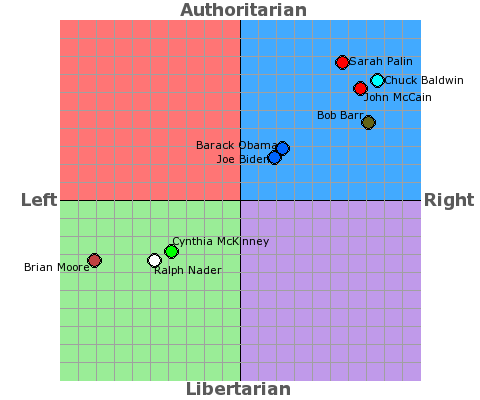
One of the problems with survey data (especially the Likert-scale type of survey represented in the Political Compass) is that magnitudes are almost meaningless. Statistically, in order for me to compare, say, my dad, with, say, John McCain or Barack Obama it has to be the case that: (1) both of those figures took the test (they didn't); and (2) the magnitudes on the scale are meaningful (they're not).

Economically, putting magnitudes on preferences (cardinal utility) is something that has been recognized as fruitless for some time, although political scientists and psychologists still try to do so. This leads to the crux of the various "impossibility theorems" in the various critiques of the notion of "social welfare" in economics.

Inter-personal comparisons of "utility" or magnitudes of preference in a survey like the Compass requires me to assume that both people know what is meant by "Agree" as opposed to "Strongly Agree" in the Likert Scale, that they agree on that meaning, and so on. Usually, people don't agree on the intensity meant by "Strongly" in these surveys and the study faces the problem of not having "Inter-Rater Reliability." For a statement like, "If economic globalisation is inevitable, it should primarily serve humanity rather than the interests of trans-national corporations," it can be hard to have strong feelings for or against because "serve humanity" can mean different things to different people. Also, are the interests of "humanity" and "corporations" necessarily conflicting? I put "agree" on this because I think that freer trade and factor movements do serve humanity even if they serve corporations in the process. How intensely to I believe this? I guess pretty strongly, but the loadedness of the question makes me tentative.

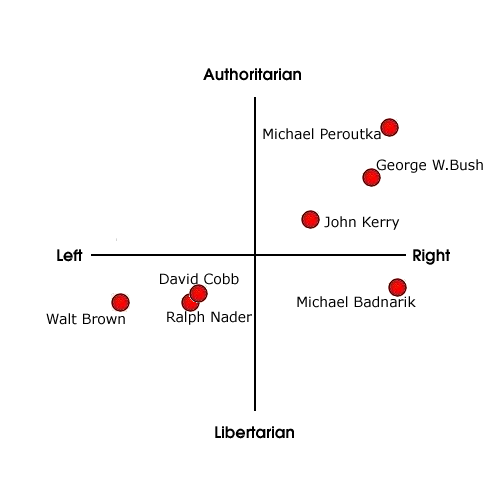
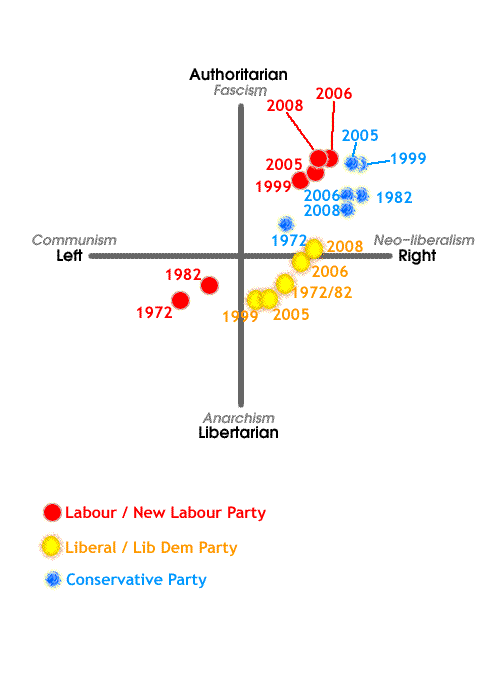
My suggestion for the authors would be to make the survey binary - "agree" or "disagree." That way, their index would map to a well-defined and well-calibrated as a ratio-scale varilable. The current scale for the responses maps to a poorly calibrated interval-scale variable (and probably give a better dispersion of views for comparisons. Here are some pictures of their comparisons of various leaders:

Leaders:
2008 US Presidential Candidates:
2004 Presidential Candidates:
UK Political Parties (Current and Over time):
Monday, August 3, 2009

WMRA: Unconstitutional Religious Tests for Political Office (2009-07-31)

WMRA: Unconstitutional Religious Tests for Political Office (2009-07-31)

Shared via AddThis

Welfare and Liberty

I was talking about the Arrow "impossibility theorem" with a friend the other day, and was reminded of a paper by Amartya Sen (1976, Economica) that proves an application of the result. It basically goes like this: The principle of Pareto Efficiency (Optimality, that if everyone is at least as well-off under a certain policy than the status quo it should be pursued) is not completely compatible with personal liberty (that each person should be free to choose for themselves). In other words, he proves "the impossibility of the Paretian Liberal" (liberal in the classical sense, i.e. "libertarian"). The crux of it is that you can ideologically favor liberalism, but in certain circumstances this will lead to a loss in welfare, or utility for certain individuals. Politically, any party will argue for either side, depending on how it suits their perceived constituencies or predetermined preferences.