follow us in feedly

Tuesday, October 19, 2010

Rare Earth, Export Restrictions, and the Terms of Trade

China has been imposing export restrictions on rare earth metals (used in many high-tech and "green economy" industries, I'm told). By restricting supply, prices rise; rents accrue to the supplier(s) at the expense of foreign buyers. This is no different from what OPEC does to manipulate the quantity supplied in order to influence the market price of oil.
How is this different from the "optimal" tariff discussed in any undergraduate textbook? The optimal tariff is couched in the context of a tariff on imports. By restricting demand, prices (of imports) fall; rents accrue to the buyer(s) and/or the treasury in the tariff-imposing country at the expense of foreign sellers. One problem with this policy is that it can and often does lead to retaliatory tariffs by the country that sells those goods being targeted by the country that initially imposed its "optimal" tariff. The first country re-retaliates, and so on resulting in a trade war. Everyone loses; think Hoover, Smoot-Hawley, and competitive devaluations and tariffs that sank the world economy deeper and deeper into the Great Depression.
Popular opinion seems adamant that we "do something". Voters, politicians, and even some very bright economists are advocating some form of punishment against China. What most popular opinion neglects (and that very smart economists should be well aware of) is that restricting exports in the way China (and OPEC) has has a very similar effect as restricting imports. In fact, in relative terms, it has the exact same impact on prices, a concept known as Lerner Symmetry.
So what does one do about it? Well, we can do nothing and minimize our losses, or we can retaliate and instigate a potential trade war.

Monday, October 18, 2010

10 Questions for N. Gregory Mankiw

This is great (Barry Ritzholz).
I don't doubt that taxes affect incentives to be productive, but N. Gregory Mankiw seems to be exaggerating them in last week's op-ed.
Read them all. They're a hoot. Here's one of my favorites.
5. You teach at Harvard and live in “Taxachusetts.” If state taxes are so important, have you considered teaching at Yale, and living in much lower state tax land of Connecticut?

Saturday, October 16, 2010

Prisonomics

How the Financial Crisis has affected inmates (here, via AT at MR):
There was an actual economic reason about this. I went away in Michigan, where a lot of people lost their houses, mostly poor people already. When they had to move away from the prison, it meant they couldn't bring their loved ones as much contraband group, which meant the price of what there was sky rocketed....Bet you didn't read about that one in the Wall Street Journal.

Sunday, October 10, 2010

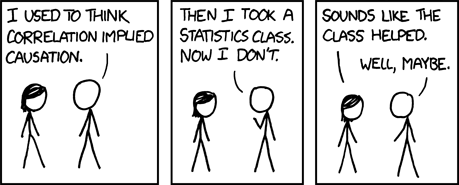
Post hoc, propter hoc


via xkcd

"Recovery" vs. "Recovered"

Economists take a lot of flak, some of it from really smart and savvy guys like Warren Buffet, for saying the recession is "officially" over and the recovery has "officially" begun. According to Buffet,
I think we're in a recession until real per capita GDP gets back up to where it was before. That is not the way the National Bureau of Economic Research measures it. But I will tell you that to any-- on any common-sense definition, the average American is below where he was before, or his family, in terms of real income, GDP.
James Hamilton defends the profession, conceding that it's a matter of semantics.
Economists have used the term "recession" to have this particular meaning-- the episode between a peak and trough-- for 150 years or so of data.

But it's not semantic, it's common sense. Think of a patient in a hospital. Don't we say a patient is "recovering" once the problem is identified, treated and beginning to improve? Sure, during your recovery you may still not be working or doing certain things the same as you did prior to your illness or injury, but things are moving in that direction. You're no longer getting sicker, you're getting well. In this context, the economic definition makes perfect (common) sense.

Thursday, October 7, 2010

Incentives or Endogeneity?

Via MR and Barry Ritholtz:
It turns out that major league hitters on the verge of a 3 handle batting average — .300 — hit an astounding .463 on their last at bat of the season.

Why? I saw several explanations, but this seems the most plausible (from the MR comments):
If a .299 hitter gets a hit in his first AB of the last game of the season, his manager takes him out. If he makes an out, he stays in the game. If he goes 0-4, he finishes at .295 or so but doesn't count in the sample of how .299 batters do in their last AB.

Seems like Tyler's assignment of the phenomenon was a jump to conclusions by an economist looking under the light instead of looking where the keys were.

Wednesday, September 29, 2010

More on small-farm organic locavorism (from Freakonomics). Just because there are fewer cases of salmonella reported on from free-range chickens doesn't mean that the risks are lower - free range farms just don't produce enough eggs for their salmonella to get noticed.

Tuesday, September 28, 2010

Chart of the Day


From the Daily Dish.

Creative Destruction

Apparently, the athletic department at VMI is switching over to digital video, judging from this email I got:

Sent with permission of the Director of Intercollegiate Athletics

The football office has approximately 250 new video tapes that we no longer need. If you can use these please contact me. Thanks!


Monday, September 27, 2010

Deception at Farmers' Markets

Via Tim Diette at WLU:

A nice example of the potential value of regulation so that consumers have information on what they are buying.

Stories from NY Times (here) and Roanoke Times (here).
I'm not a expert in the economics of regulation, but I do a bit of political economy in my research, and I did OK in the game theory portion of my micro sequence in grad school, so here's how I'd see this one playing out. Regulation will ultimately be lobbied for most by big players in the organic/local market (think whole foods, etc.). My thinking here is that the big producers actually have less incentive to "cheat" by outsourcing produce advertised as local and/or using pesticide-enhanced produce, because everyone will remember it if Whole Foods gets busted; no one will remember if Johnny Farmer does. Consumer groups will support it, but the final product will mainly serve to: (1) bar entry for small sellers; and (2) help the same big players signal their reputation cheaply. It will go over great for a while, but eventually, enough of the relatively honest small producers will collectively complain about the onerous opportunity-killing regulations. If they succeed, we'll be right back at square one.

Shortcut to Serfdom

This piece does a good job of the real and tangible threats to liberty that are out there right now. Many started under "W" but have been continued and in some cases escalated under Obama. Mr. Friedersdorf points out:
Seven decades have passed since The Road to Serfdom was published. Social democracy hasn’t yet led Europe or any of its diverse countries into serfdom. On the contrary, they’re are among the most free and prosperous countries in the history of human civilization. I prefer the American system. It’s better, all things considered. In order to make the case for it, we need not pretend that the people of Europe are in chains.

There are real threats to liberty, but they have less to do with Obamacare, bailouts, or taxes. Which does the conservative Friedersdorf prefer?
Forced to choose, I’d rather live in the ACLU’s idea of the perfect America than a country where we repeal Obamacare, eliminate earmarks, and persist in chipping away at civil liberties to fight drugs and terrorists. The former may be a “road to serfdom.” The latter is a shortcut to the same place.

I recommend the whole piece, but I do disagree with the statement, "The last two presidents have asserted authority unprecedented in American history." Sadly, the current circumstances are not particularly unprecedented or even extraordinary. We had the internment camps during World War II, McCarthyism, J. Edgar Hoover's domestic spying, Watergate, Iran Contra... There is a seemingly endless list of landmark historical instances where our government acted in contradiction to the liberties proscribed in the constitution. On the broader issue, however (that we need to guard our civil liberties much more than we need to worry about some perceived injustice stemming from our personal disagreements with a particular economic policy, the author hits it right on the head.

Thursday, September 23, 2010

Some links: Who's lobbying against pot; how cops are catching those who are for it

Turns out, beermakers and police (two people who benefit most economically from prohibition) lobby most (Huffington Post).
Do I see an unholy freedom alliance between Teapartiers and NORML in America's future (420 Tribune)?
Is more vote-buying a good thing or a bad thing (Marginal Revolution)?
If you pay someone to help you cheat, do you deserve a refund when you discover that they cheated (Dan Ariely)?
How to eat a muffin (Incidental Economist). The second I read this, I realized that I already eat muffins this way, even when I'm not walking.
Imperialistic (or, mercantilistic?) Economists (Justin Wolfers).

One good sentence on subsidies

From Free Exchange:
The upside to cash-benefits is that it forces policymakers to confront the trade-offs involved in delivering a certain subsidy and evaluate whether it makes sense.

Tuesday, September 21, 2010

Three good sentences

Liberal arts education has taken a beating lately from a wide range of critics (for examples on the economics department side of things see hereor here, and for a general critique see here or here). Tyler Cowen makes a good (and concise!) defense here. Here's the good stuff:
A liberal arts education helps us think with greater subtlety, even if it does not improve our performance on subsequent standardized tests. I see an impact here even on the lesser students in state universities. It also helps explain how the U.S. so suddenly leaps from having so-so high schools to outstanding graduate schools; how many other countries emphasize liberal arts education in between?

I wonder how Tyler (a libertarian, Austrian-leaning economist) feels about the fact that a significant portion of that liberal arts education is heavily subsidized?

Thursday, September 9, 2010

Chart of the Day

A rare good use of a pie chart.


A little economic knowledge can do quite a bit of harm

From Free Exchange:
I've certainly met my share of Econ 101 robots, who can't talk beyond the "markets are always right" models one gets in early economics classes.

I know some Ph.D. trained economist robots, who also can't talk beyond the "markets are always right" mantra. Some economic problems, as it turns out, are more complex than the "X marks the spot" pirate logic (AAARRGH!) of simple supply and demand.

Big, bad government

If the government's intrusiveness in the real economy can be at all proxied by public sector employment, then the Tea Party should take note of what's happened in the last two years.