| The Daily Show With Jon Stewart | Mon - Thurs 11p / 10c | |||
| Poll Bearers | ||||
| ||||
For those who are interested, here's a link to the equally-funny "moment of zen..."

| The Daily Show With Jon Stewart | Mon - Thurs 11p / 10c | |||
| Poll Bearers | ||||
| ||||
| The Daily Show With Jon Stewart | Mon - Thurs 11p / 10c | |||
| Moment of Zen - Coulter Sells More Books | ||||
| ||||


In my view, the reason why so many hold onto these views is because it's so much easier to remain ignorant, and leap to the conspiracy view, than to do the hard work to understand why the statistics are imprecise measures of economic concepts, and why they are revised over time. After all, the former requires nothing more than taking somebody's word, the latter entails reading the supporting documentation, comprehending what the terms used mean, and applying some basic math and statistics skills...In other words the reason conspiracy theories attract a nice crowd of supporters is because people are "rationally ignorant." Being informed takes a lot of effort, and it's easy to believe a plausible lie (along with a dose of paranoia that the other side is lying) than it is to be bothered with the facts.

 A normal good is a good whose demand increases with income. Here is the correlation between pot use and per capita gross state product (GSP).
6. Limiting inequality will do more to check bad governance than will the quixotic libertarian attempt to limit the size of government.
8. We should support free trade, more immigration, and more foreign aid, but the nation-state will remain the fundamental locus for redistribution. That means helping the poor at home more than abroad; a decision to do otherwise would destroy political equilibrium and make everyone worse off.
But all the tools in the world are useless if we lack the imagination needed to build the right models. Models are built to answer specific questions. When a theorist builds a model, it is an attempt to highlight the features of the world the theorist believes are the most important for the question at hand. For example, a map is a model of the real world, and sometimes I want a road map to help me find my way to my destination, but other times I might need a map showing crop production, or a map showing underground pipes and electrical lines. It all depends on the question I want to answer. If we try to make one map that answers every possible question we could ever ask of maps, it would be so cluttered with detail it would be useless, so we necessarily abstract from real world detail in order to highlight the essential elements needed to answer the question we have posed. The same is true for macroeconomic models.I may have to use that in class.
If you like the Post Office and the Department of Motor Vehicles and you
think they’re run well, just wait till you see Medicare, Medicaid and health
care done by the government.
- "Economist" Arthur Laffer during an appearance on CNN.
In a badly-managed business, you get massively-multiplying meetings: every
decision, no matter how tiny, ends up being debated and signed off on
by far too many people, who thereby get to feel (and show their bosses)
that they’re Doing Something.
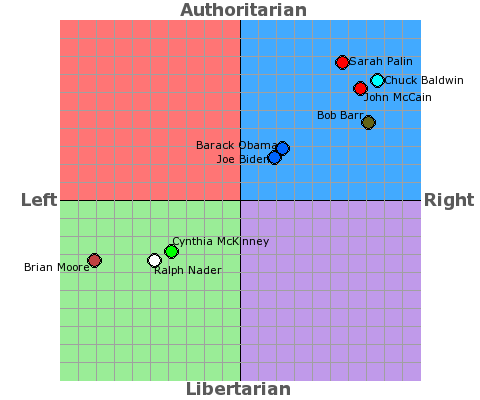
 2008 US Presidential Candidates:
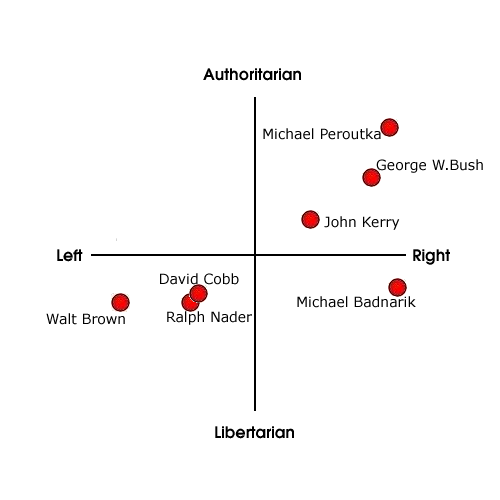
 2004 Presidential Candidates:
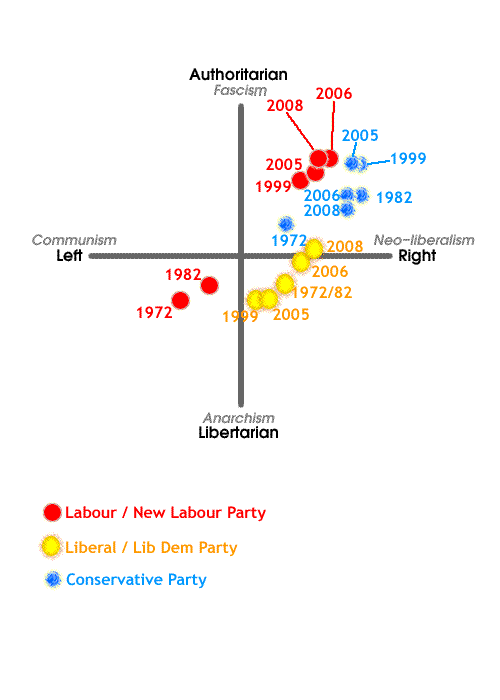
  UK Political Parties (Current and Over time):
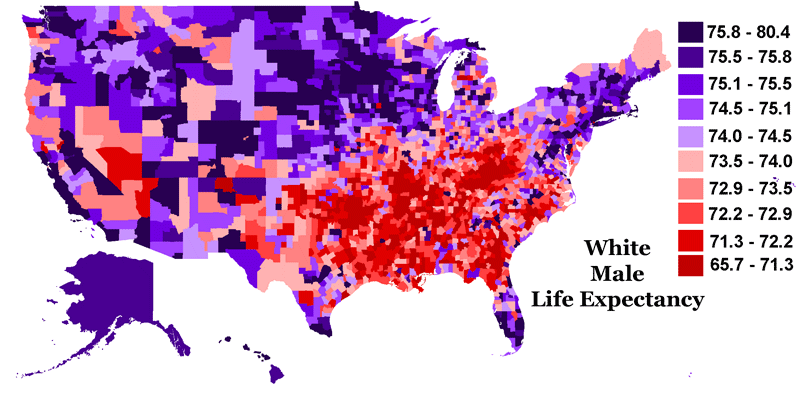
At birth, someone living in the Netherlands can expect to live 2.35 years longer than someone born in the US, but at age 65, the difference is reversed, and someone living in the US can expect to live 0.4 years longer than someone living in the Netherlands. This difference can be explained by assuming that semi-socialized health care is better for young and worse for old people, or, at least as likely, different policies are not the main cause of the difference
Sources: CDC national vital statistics 2004, www.cdc.gov/nchs/data/nvsr/nvsr56/nvsr56_09.pdf and RIVM 2007 levensverwachting, www.rivm.nl/vtv/object_document/o2309n18838.html (in Dutch)
So, the question still remains on distribution. Is it better to increase the likelihood that citizens are able to reach the age of 65 or that those who do (either because they are congenitally wealthier or healthier) live even longer? There are a lot of interesting tradeoffs in the debate, and the politicians are not focusing on any of them because the old conflicts over class and culture play better to less affluent voters (remember more than half of all Americans have below-average incomes).

From a very good piece in the NYTimes on lobbying:
Hint: McAllen Texas has the highest health care costs in the country.One of the largest sources of campaign contributions to Senate Democrats during this year’s health care debate is a physician-owned hospital in one of the country’s poorest regions that has sought to soften measures that could choke its rapid growth.
According to the Times, the hospital has been quite successful in its efforts. And where is this powerful hospital with all the lobbying money located? Why in the metropolitan area of McAllen, Texas. McAllen, Texas? Hmmm...now where I have heard that name before?
It's worth pointing out that PowerPoint presentations are generally better than many older classroom technologies, like slate chalkboards or overhead transparencies filled with hand-scrawled notes that students struggled to decipher. So computers have probably led to a slight improvement in teaching.So, as usual, it's not really so much the technology as much as it is how you use it. Technically, I use "smart boards" and "Power Point" but I almost never use pre-made slides anymore. I use the laser pen and palatte to draw and write the main points while I mention them. Over the last couple of semesters, students who complained about "boring power point" lectures were usually ones who had other issues with the difficulty of statistics generally or their grade specifically.

Small businesses also pay more for health insurance than large companies. According to the Commonwealth Fund, small businesses now pay 18 percent more than large businesses pay to obtain comparable insurance.Adverse selection?
One point was that health is a random event. It's not like buying automobiles. Whether you're sick or not is hard to predict. Some get sick and some don't. That uncertainty makes it an ideal scenario for insurance. Some houses burn and some don't, but you know whose. So you have fire insurance. (And by the way, financial problems have the same characteristics, and I was always interested in the subject -- the uncertainty.)Later,
But in the case of health care there are three players: the insurance company with the health plan, the physician, and the patient. The physician presumably has a better knowledge of what the patient needs -- at least better than the insurance company does. So the insurance company could never put together a bill. There is also a Physician and patient relationship, but the physician knows more than the patient.In other words, even if a 2 quart bottle of ketchup costing twice the price of a 1 quart bottle shows market efficiency for ketchup, insurance (and financial) markets work much differently. Of course, I've made these points about adverse selection and moral hazard casually myself, too, but getting them from a Nobel (who isn't Krugman) probably adds more weight.
There are information asymmetries in this story. Health insurance is limping along. It's limited in scope, and then you other consequences. Insurance companies have high premiums to protect themselves. The ones who come to the insurance company are sicker and the people have to pay more. You have adverse selection. You have moral hazard. And the doctor does what's on the safe side -- defensive medicine -- without regard to cost. These are fundamental conditions that make health insurance difficult.
I thought yesterday was funny. Bill-O shows his complete lack of statistical literacy in this clip.
I find one meeting can sometimes affect a whole day. A meeting commonly blows at least half a day, by breaking up a morning or afternoon. But in addition there's sometimes a cascading effect. If I know the afternoon is going to be broken up, I'm slightly less likely to start something ambitious in the morning. I know this may sound oversensitive, but if you're a maker, think of your own case. Don't your spirits rise at the thought of having an entire day free to work, with no appointments at all? Well, that means your spirits are correspondingly depressed when you don't. And ambitious projects are by definition close to the limits of your capacity. A small decrease in morale is enough to kill them off.
Each type of schedule works fine by itself. Problems arise when they meet. Since most powerful people operate on the manager's schedule, they're in a position to make everyone resonate at their frequency if they want to. But the smarter ones restrain themselves, if they know that some of the people working for them need long chunks of time to work in.
At a recent town-hall meeting in suburban Simpsonville [SC], a man stood up and told Rep. Robert Inglis (R-S.C.) to "keep your government hands off my Medicare.""I had to politely explain that, 'Actually, sir, your health care is being provided by the government,'" Inglis recalled. "But he wasn't having any of it."

 So, basically, 48 million Americans are on the horizontal segment; they don't pay for insurance, and they do not receive any benefits. Then if they pay some threshold per year (say, 2,000 for themselves and 5,500 paid by their employer as a "non-wage benefit") they get minimal coverage that increases in generosity as more is paid in.
Thus, there would still be a discontinuity in the relationship, but at the bottom could be lifted without necessarily changing the rest. But, you might say, what about people who get seduced by the cheaper option? Here I ask, "what's the big deal?" The fact that they choose it when there are more generous (and more expensive options) proves that they are better off, on average, by revealed preference, and they have money to save up in case they want to pay in for a big procedure that the big mean bureaucrats won't pay for. The curve might look something like this:
 If there are no distortions, then maybe the Feds insure 70 million or so, instead of the 48 million that were uninsured (but they also insure another 45-50 million from other existing public programs for a total of about 120 million people) If there are distortions, it might shift the curved segment like this:
Here, the benefits for people paying might decline, but the question is how much, it is unlikely that rich folks won't still have a "Cadillac option" that is as generous as they want it to be. (Another question is who are these people receiving the lowest benefits "on the new curve?" Are they people who had private insurance before, or are they on medicare/aid or other publicly-funded benefits? Are they people who were already at that level on the curve but decide to pay for the private option in spite of an available public option, i.e. to what extent are the "payers" moving horizontally, receiving the same benefits, versus down, receiving less, but still paying?)
One thing that this doesn't suggest, is that assuming inferior care by the government private insurance would go out of business. For that to happen, it's almost as if you would have to admit that the government plan is at least as good as a marjority of the points "on the curve." If they offer higher quality they should be able to keep charging a profitable price and compete on quality. If you think the government would compete the private insurers out of the market entirely, it's hard to make the case that their quality wouldn't be somewhat comparable.
| Count of Vote | Party | |||
| Vote | D | I | R | Grand Total |
| Yea | 42 | 1 | 15 | 58 |
| Nay | 14 | 1 | 25 | 40 |
| Not Voting | 2 | 2 | ||
| Grand Total | 58 | 2 | 40 | 100 |
| Chi-Squared Test for Independence: | 15.207 | |||
| Count of Vote | Party | ||
| Vote | D | R | Grand Total |
| Nay | 2 | 7 | 9 |
| Yea | 10 | 5 | 15 |
| Grand Total | 12 | 12 | 24 |
| Chi-Squared Test for Independence: | 4.44 | ||
I came across an example for teaching statistics from Gelman and Nolan (2002), Teaching Statistics: A Bag of Tricks that was interesting (here is a link to a journal article published on it in The American Statistician). Suppose that there is a jar of quarters filled to a certain line. We don't know how many are in the jar, but after pooling information from a lot of guesses we have an average "guess" of 160, and the standard deviation of the guesses is 60, so let's take that as the distribution, supposing it is "normal." Now, if I want to guess the number of quarters in the jar (and the payoff is fixed at, say $50), it is a simple matter of maximizing the likelihood function, L() (which is equivalent to minimizing your squared losses):
max{(1/sqrt(22))*exp((-1/22)*(x-)2)}.
Maximizing, and plugging in 160 and 60 for and , respectively, you get back the intuitive guess – 160, the average you started with.
But that's not how these carnival games typically work. The guesser gets what's in the jar, usually. So, to find the guess that maximizes x times the likelihood function:
max{(x/sqrt(22))*exp((-1/22)*(x-)2)},
which is equivalent to maximizing the natural log of xL(q), i.e.
max{ln(x)- (1/22)*(x-)2)},
since the natural log is a monotonic function. The first-order condition is:
1/x - (1/2)*(x-) = 0,
and plugging in 160 and 60 for and , we get:
x = 180.
This is related to the moral hazard involved with stock and asset pricing (or, the recommendations and ratings put out to customers by banks, brokerages, and ratings institutions). Sure, we could estimate an accurate value for an asset, but when your payoff is positively correlated with the value of your guess, you'll have a systematic incentive to guess high. If enough of these "high" guesses accumulate over time, eventually it becomes obvious that the "guesses" being collected in the market are way off from the "true" expected value.


Visit msnbc.com for Breaking News, World News, and News about the Economy


Tom Friedman has often observed that poorly educated, unemployed youth in
Arab countries turned to fundamentalism. He blames the inefficient kleptocracies
that run these countries for these backward attitudes.
Is something like this
happening in the solid Republican states?